
Complete Guide for Pakistani Students
Early childhood is one of the most important stages of human development. The education, care, environment and experiences children receive during their early years can have a long-term impact on their learning, behavior and overall development.
A PhD in Early Childhood Education is designed for professionals and researchers who want to develop advanced knowledge in early childhood education, child development, teaching and learning, curriculum, educational leadership and related areas.
Malaysia offers several opportunities for students who want to pursue doctoral research in Early Childhood Education. Malaysian universities provide research-based and mixed-mode doctoral programmers, with opportunities to study important issues affecting children, families, teachers and early learning environments.
This guide explains the important information Pakistani students should know before applying for a PhD in Early Childhood Education in Malaysia for the 2026–2027 intake.
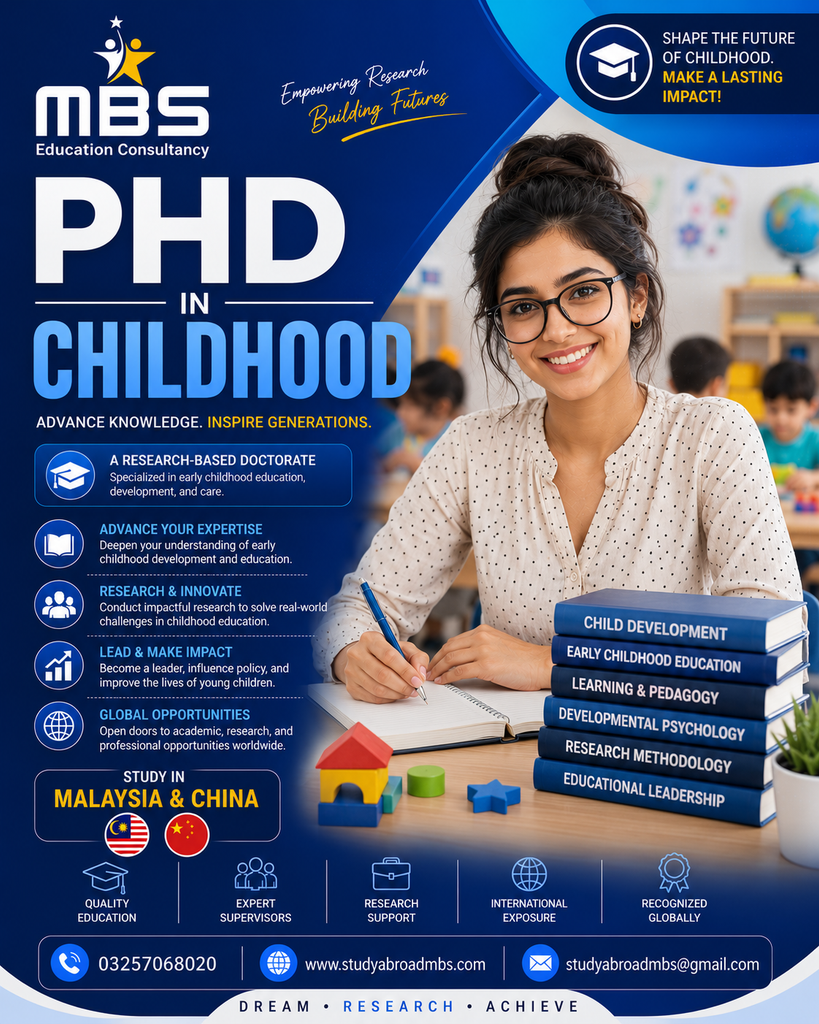
What is a PhD in Early Childhood Education?
A PhD in Early Childhood Education is an advanced doctoral degree focused on research related to young children and early learning.
The programmed allows students to investigate a specific problem or topic in depth and produce original research that can contribute to the field of education.
Depending on the university and research area, students may study topics related to child development, early childhood curriculum, teaching methods, educational psychology, family involvement, inclusive education, leadership and management, assessment and children’s wellbeing.
The programmed is suitable for educators, lecturers, researchers, education professionals and other qualified candidates who want to develop expertise in early childhood education.
Why Study PhD in Early Childhood Education in Malaysia?
Malaysia is becoming an attractive destination for international students interested in education and research.
Some important reasons to consider Malaysia include:
- Research opportunities in Early Childhood Education
- Experienced academic supervisors
- International learning environment
- Modern educational facilities
- Opportunities for academic and professional development
- Comparatively affordable study costs
- Growing focus on children’s education and wellbeing
- Opportunities to conduct research related to real-world educational issues
- Potential access to scholarships and research funding
Malaysia also offers doctoral programmers where students can explore early childhood issues from educational, developmental, social and policy perspectives.
Popular Research Areas in Early Childhood Education
One of the most important decisions when starting a PhD is choosing a suitable research area.
Popular areas include:
- Child Development
- Early Childhood Curriculum
- Teaching and Learning
- Early Childhood Pedagogy
- Children’s Learning and Development
- Educational Psychology
- Child Behavior
- Children’s Wellbeing
- Inclusive Early Childhood Education
- Special Needs Education
- Early Childhood Assessment
- Early Literacy
- Early Numeracy
- Science and Technology in Early Childhood
- Learning Through Play
- Parenting and Family Engagement
- Family and Community Education
- Early Childhood Leadership
- Management of Early Childhood Centers
- Teacher Professional Development
- Educational Policy
- Digital Learning in Early Childhood
- Technology and Young Children
- Multicultural Early Childhood Education
The exact research areas available depend on the university and the expertise of its academic supervisors.
Duration of PhD in Early Childhood Education
The duration depends on the university, study mode and student’s research progress.
Many Malaysian doctoral programmers in Early Childhood Education have a minimum duration of around 3 to 4 years for full-time students.
For example, some programmers specify a minimum of 6 semesters, while others structure the programmed over approximately four years.
Part-time study may take longer, depending on university regulations.
Students should check the specific minimum and maximum candidature period of their chosen university before applying.
Study Structure
The structure of a PhD in Early Childhood Education depends on the university.
Some universities offer a full research programmed, while others may use a mixed-mode structure that combines coursework with research.
A typical doctoral journey may include:
Research Methodology
Students develop advanced knowledge of educational research methods, data collection, data analysis and academic research practices.
Coursework
In mixed-mode programmers, students may study advanced subjects related to early childhood education, child development, curriculum, pedagogy, leadership and research.
Research Proposal
Students prepare a research proposal explaining the research problem, objectives, methodology and expected contribution.
Research and Data Collection
After approval, the student conducts research according to the approved methodology.
This may involve interviews, observations, surveys, assessments, case studies, document analysis or other appropriate research methods.
Thesis
The findings are analyzed and presented in a doctoral thesis.
Viva Voce
At the final stage, students may need to defend their research and thesis before academic examiners.
Intakes for 2026–2027
PhD intake dates vary between Malaysian universities.
Some universities offer specific intakes during the year, while research-based programmers may have more flexible application periods.
For the 2026–2027 intake, students should start the application process early because admission may depend on research topic, faculty availability and supervisor availability.
Students should also allow sufficient time for university admission and Malaysian student pass processing.
Eligibility for PhD in Early Childhood Education
The usual academic requirement is a relevant Master’s degree.
Applicants may come from backgrounds such as:
- Early Childhood Education
- Education
- Educational Studies
- Child Development
- Educational Psychology
- Teaching
- Special Education
- Primary Education
- Educational Leadership
- Other related fields
The exact entry requirements depend on the university.
Some institutions may consider applicants with relevant professional experience or other academic qualifications under specific admission pathways.
Academic Requirements for Pakistani Students
Pakistani students should normally prepare their complete academic record before applying.
Common requirements may include:
- Bachelor’s degree
- Master’s degree
- Academic transcripts
- Degree certificates
- Research proposal
- Updated CV
- Passport
- English language evidence, where required
- Recommendation letters, if required
- Relevant work experience documents
- Research publications, if available
A strong academic background in education or a related field can be helpful when applying for a doctoral programmed.
English Language Requirements
International students may need to demonstrate English language proficiency.
Depending on the university, accepted qualifications may include:
- IELTS
- TOEFL
- PTE Academic
- Other recognized English language qualifications
Requirements can vary significantly between universities.
For example, some Malaysian Early Childhood Education doctoral programmes specify IELTS 6.0 or an equivalent English qualification for international applicants.
Students should always confirm the current English requirement of their selected university before submitting an application.
Research Proposal
The research proposal is an important part of a PhD application.
A good proposal should clearly explain what you want to research and why the research is important.
It may include:
- Research title
- Introduction and background
- Research problem
- Research gap
- Research objectives
- Research questions
- Literature review
- Research methodology
- Expected findings
- Significance of the study
- References
For example, a student may propose research on the effect of digital technology on early childhood learning.
Another student may study the role of parents in children’s early literacy development or investigate inclusive teaching practices in preschool education.
The research topic should be realistic and should match the expertise of the university and potential supervisor.
Finding the Right Supervisor
A suitable supervisor can make a major difference to the PhD experience.
Students should look for academic staff whose research interests are related to their proposed topic.
For example, if your research is about child development, you should ideally find a supervisor with experience in child development or developmental education.
If your topic is about curriculum and pedagogy, look for supervisors who have research experience in early childhood curriculum and teaching practices.
Supervisor availability should also be confirmed before finalizing the application.
Documents Required
Pakistani students may generally need the following documents:
- Valid passport
- Passport-size photographs
- Bachelor’s degree certificate
- Bachelor’s academic transcripts
- Master’s degree certificate
- Master’s academic transcripts
- Updated CV
- Research proposal
- English language certificate, if required
- Recommendation letters, if required
- Employment or experience letters, where applicable
- Research publications, if available
- Any additional documents requested by the university
All documents should be properly prepared and submitted according to the university’s requirements.
Admission Process
The general admission process for a PhD in Early Childhood Education is:
Step 1 – Choose a University
Select a Malaysian university offering a suitable doctoral programmed in Early Childhood Education or a closely related field.
Step 2 – Select Your Research Area
Decide which area of early childhood education you want to research.
Step 3 – Prepare Your Research Proposal
Develop a clear and practical research proposal.
Step 4 – Identify a Supervisor
Find a potential supervisor whose research interests match your proposed topic.
Step 5 – Prepare Your Documents
Collect your academic certificates, transcripts, CV, passport, research proposal and other required documents.
Step 6 – Submit Your Application
Submit your application according to the university’s admission procedure.
Step 7 – Interview or Research Discussion
Some universities may require an interview or discussion about your proposed research.
Step 8 – Receive the Offer Letter
If your application is approved, the university will issue an offer letter.
Step 9 – Student Pass Process
After admission, international students can proceed with the required Malaysian student pass and visa procedures.
Step 10 – Start Your PhD
After completing the required formalities and arriving in Malaysia, students can begin their doctoral studies and research.
Student Visa for Pakistani Students
Pakistani students need to complete the Malaysian student pass process before starting their studies.
The process generally involves:
- University admission
- Offer letter
- Student Pass application
- Visa-related approval procedures
- Required pre-arrival arrangements
- Travel to Malaysia
- Medical screening
- Student Pass endorsement
Students should carefully follow the latest instructions provided by their university and the relevant Malaysian authorities because immigration and student pass requirements can change.
PhD in Early Childhood Education Fees in Malaysia
Tuition fees vary depending on the university and programmed structure.
International students should expect different fee levels between universities.
Some research-based Early Childhood Education programmers may be comparatively affordable, while other universities may charge higher fees.
As a general planning estimate, students may consider approximately RM30,000 to RM70,000 or more for the overall doctoral programmed, depending on the university and study structure.
This is only a planning range and should not be treated as a fixed fee.
Additional costs may include registration, student pass, insurance, university services and other administrative charges.
Living Expenses in Malaysia
Living expenses depend on the city and personal lifestyle.
Students should budget for:
- Accommodation
- Food
- Transportation
- Mobile and internet
- Study materials
- Personal expenses
- Medical and insurance-related costs
A reasonable planning budget can be around RM1,200 to RM2,500 or more per month.
Students living in major cities or choosing private accommodation may have higher monthly expenses.
Scholarships and Funding
Students may explore different funding opportunities for doctoral study.
Possible sources include:
- University scholarships
- Research scholarships
- Merit-based funding
- Graduate research assistantships
- Research grants
- Faculty research projects
- Government scholarship schemes
- International funding opportunities
Scholarship availability and eligibility vary from university to university.
Students with strong academic records, research experience and a well-developed research proposal may have better opportunities for research funding.
Career Opportunities After PhD in Early Childhood Education
A PhD in Early Childhood Education can lead to a variety of academic, research and leadership careers.
Graduates may work as:
- University Lecturer
- Professor
- Early Childhood Education Researcher
- Education Researcher
- Curriculum Specialist
- Early Childhood Consultant
- Educational Policy Specialist
- Teacher Educator
- Academic Coordinator
- Early Childhood Programmed Director
- Education Administrator
- Research Fellow
- Education Project Manager
- Early Childhood Centre Consultant
- Education Policy Advisor
Graduates can work in universities, research organizations, educational institutions, government departments, NGOs, education companies and other organizations working with children and education.
Who Should Study a PhD in Early Childhood Education?
This programmed may be suitable for:
- Early childhood educators
- Preschool teachers
- Education professionals
- University lecturers
- Researchers
- School administrators
- Curriculum specialists
- Education consultants
- Professionals working with children and families
- Students interested in educational research
It is especially suitable for people who want to contribute to the improvement of early childhood education through research, teaching, policy or leadership.
Is a PhD in Early Childhood Education Difficult?
A PhD is a serious academic commitment, regardless of the subject.
Early Childhood Education research can involve extensive reading, data collection, analysis, academic writing and long-term independent research.
Students need patience, strong communication skills, critical thinking and the ability to work independently.
However, with a clear research topic, good supervision and consistent effort, students can successfully complete their doctoral studies.
Advantages for Pakistani Students
Studying a PhD in Early Childhood Education in Malaysia can provide Pakistani students with:
- International academic exposure
- Advanced research skills
- Experience with international education practices
- Opportunities for academic networking
- Exposure to different approaches to child development and education
- Research and publication experience
- Opportunities for careers in academia and education
- A pathway toward higher-level educational leadership
The international research experience can also help graduates contribute to the development of early childhood education in Pakistan and other countries.
Estimated Budget
Before applying, students should prepare a complete financial plan.
The overall budget may include:
- Application and registration fees
- Tuition fees
- Student pass and visa-related expenses
- Accommodation
- Food
- Transportation
- Medical and insurance costs
- Study materials
- Personal expenses
The total cost will depend on the university, city, accommodation and duration of study.
Important Things to Check Before Applying
Before selecting a PhD in Early Childhood Education in Malaysia, students should carefully check:
- University recognition and accreditation
- Programmed structure
- Research areas
- Supervisor availability
- Entry requirements
- English language requirements
- Tuition fees
- Additional charges
- Study duration
- Research facilities
- Publication requirements
- Student pass requirements
- Scholarship opportunities
Most importantly, students should select a research topic that matches their academic background and long-term career goals.
Frequently Asked Questions
Can Pakistani students study PhD in Early Childhood Education in Malaysia?
Yes. Pakistani students can apply to Malaysian universities offering suitable doctoral programmers, provided they meet the university’s academic, English language and other admission requirements.
What qualification is normally required?
A relevant Master’s degree is commonly required, although specific universities may have different entry pathways.
How long does the PhD take?
A full-time PhD commonly takes around 3 to 4 years, depending on the university and research progress.
Do I need IELTS?
Many universities require English language proficiency from international students. The exact requirement varies by institution.
Is the PhD research-based?
Many Early Childhood Education PhD programmers in Malaysia are research-based. Some universities may offer a mixed-mode structure that combines coursework and research.
Can I choose my own research topic?
Students can generally propose a research topic, but it must be academically suitable and aligned with available supervision and university research areas.
What can I research in Early Childhood Education?
You can research areas such as child development, curriculum, teaching methods, play-based learning, early literacy, assessment, inclusive education, parenting, technology, teacher development and children’s wellbeing.
What can I do after completing the PhD?
Graduates can pursue careers in universities, research institutions, educational organizations, government departments, NGOs and education-related industries.
Conclusion
A PhD in Early Childhood Education in Malaysia can be a valuable choice for Pakistani students who want to build an advanced career in education, research, teaching and educational leadership.
The programmed allows students to investigate important issues related to children’s development, learning, curriculum, families, teachers and early childhood services.
For the 2026–2027 intake, students should start preparing early, particularly their academic documents, English language requirements, research proposal and supervisor selection.
Choosing the right university and research topic is one of the most important steps. With proper planning and a strong research idea, a PhD in Early Childhood Education can provide valuable international academic experience and open the door to long-term careers in education and research.