
Complete Guide for Pakistani Students
Study Bachelor in Computer Engineering in Malaysia
Computer Engineering is a field that combines computer science, electronics, electrical engineering and modern technology. It is an excellent choice for students who are interested in understanding how computers and digital systems work, from hardware components to software and embedded systems.
A Bachelor in Computer Engineering in Malaysia can help students develop both theoretical knowledge and practical engineering skills. Students learn how computer hardware is designed, how software interacts with hardware and how modern digital systems are developed.
For Pakistani students, Malaysia can be an attractive destination for undergraduate engineering education because of its international academic environment, modern facilities and wide range of technology-focused programs.
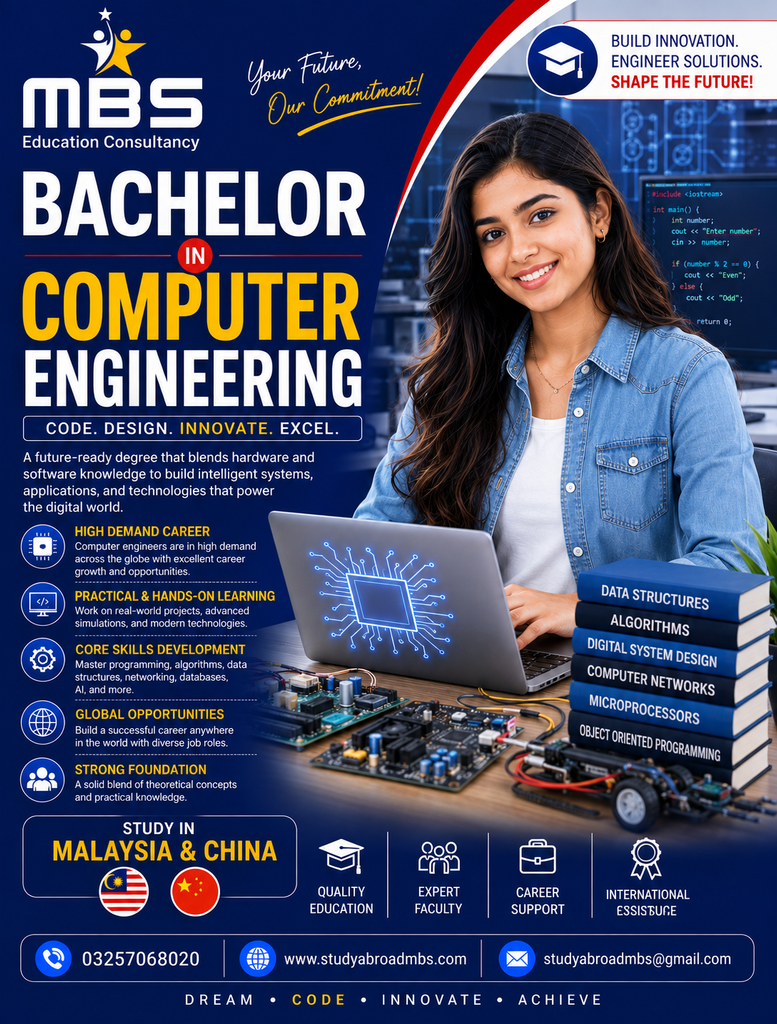
What is a Bachelor in Computer Engineering?
A Bachelor in Computer Engineering is an undergraduate engineering degree that focuses on the design, development and integration of computer hardware and software systems.
Unlike programs that focus mainly on software, Computer Engineering also deals with the physical and electronic components that make computing systems work.
Students commonly study:
- Computer Hardware
- Programming
- Digital Electronics
- Microprocessors
- Microcontrollers
- Computer Architecture
- Embedded Systems
- Operating Systems
- Computer Networks
- Robotics
- Artificial Intelligence
- Internet of Things
- Control Systems
- Electronic Circuits
The program is suitable for students who enjoy computers, mathematics, electronics, engineering and problem-solving.
Why Study Computer Engineering in Malaysia?
Malaysia offers a growing environment for international students interested in engineering and technology.
Some important advantages include:
- Internationally oriented universities
- Modern engineering laboratories
- Technology-focused programs
- Practical and project-based learning
- English-medium education in many programs
- Multicultural international environment
- Competitive education costs compared with some Western destinations
- Opportunities to study modern engineering technologies
- Exposure to an international academic environment
- Growing technology and manufacturing sectors
For Pakistani students, Malaysia can provide an opportunity to gain international engineering education while developing practical technical skills.
Who Can Apply for Bachelor in Computer Engineering?
Pakistani students who have completed Intermediate, A-Levels or another recognised equivalent qualification may be eligible to apply.
Common academic backgrounds include:
- FSc Pre-Engineering
- FSc with Mathematics
- ICS
- A-Levels
- Intermediate or equivalent qualifications
- Other recognized international qualifications
Students with Mathematics, Physics and computer-related subjects may find Computer Engineering particularly suitable.
However, requirements vary between universities, so students should always check the specific entry requirements of their selected institution.
Academic Requirements for Pakistani Students
Universities normally assess the student’s previous academic qualification before offering admission.
Applicants may be required to have:
- Intermediate/HSSC or equivalent qualification
- Suitable academic grades
- Mathematics
- Physics or related science subjects, depending on the program
- Recognized academic documents
- English language proficiency where required
Engineering programs can have specific subject requirements, so students should confirm their eligibility before applying.
Duration of Bachelor in Computer Engineering
A Bachelor in Computer Engineering in Malaysia typically takes:
3 to 4 years
The exact duration depends on the university and curriculum.
The program may include:
- Engineering laboratory work
- Practical training
- Industrial training
- Engineering projects
- Final-year project
Students can gain both theoretical knowledge and hands-on engineering experience during the degree.
What Will You Study in Computer Engineering?
Computer Engineering covers a wide range of subjects from both computing and engineering.
Mathematics and Engineering Fundamentals
Students may study:
- Engineering Mathematics
- Calculus
- Differential Equations
- Probability and Statistics
- Engineering Physics
- Engineering Fundamentals
Programming and Computing
Common subjects may include:
- Programming Fundamentals
- Object-Oriented Programming
- Data Structures and Algorithms
- Computer Programming
- Operating Systems
- Computer Networks
- Database Systems
Electronics
Students may learn:
- Electrical Circuits
- Electronic Devices
- Digital Electronics
- Analog Electronics
- Digital Logic Design
- Electronic Systems
Computer Engineering
Important subjects can include:
- Computer Architecture
- Microprocessors
- Microcontrollers
- Embedded Systems
- Computer Organization
- Hardware Design
- System Design
Advanced Technology
Depending on the university, students may also study:
- Artificial Intelligence
- Machine Learning
- Robotics
- Internet of Things
- Computer Vision
- Embedded AI
- Cyber security
- Cloud Computing
Main Areas of Computer Engineering
1. Computer Hardware
Students learn how computer systems and electronic components are designed and integrated.
2. Embedded Systems
Embedded systems combine hardware and software to control devices and machines.
They are commonly used in:
- Cars
- Medical equipment
- Smart appliances
- Industrial machines
- Consumer electronics
3. Computer Architecture
Students learn how processors, memory and other computer components work together.
4. Digital Systems
This area focuses on digital circuits, logic systems and digital hardware design.
5. Microprocessors and Microcontrollers
Students learn how processors and microcontrollers are programmed and used in electronic systems.
6. Robotics
Computer Engineering can provide a foundation for developing robotic systems by combining programming, electronics and control systems.
7. Internet of Things
Students can learn how physical devices communicate, collect information and connect to digital systems.
Popular Computer Engineering Specializations
Depending on the university, students may develop expertise in areas such as:
- Embedded Systems
- Computer Hardware
- Robotics
- Artificial Intelligence
- Internet of Things
- Computer Architecture
- Digital Systems
- Microelectronics
- Computer Networks
- Cyber security
- Automation
- Control Systems
- Smart Systems
- Machine Learning
- Semiconductor Technology
Computer Engineering vs Computer Science
These two programs are closely related but have different areas of focus.
Computer Engineering
Computer Engineering focuses on:
- Hardware
- Electronics
- Computer architecture
- Embedded systems
- Microprocessors
- Digital systems
- Programming
- Hardware-software integration
Computer Science
Computer Science generally focuses more on:
- Programming
- Algorithms
- Software development
- Data structures
- Artificial Intelligence
- Computing theory
- Databases
Students who are interested in both hardware and software may prefer Computer Engineering.
Computer Engineering vs Software Engineering
Computer Engineering
Focuses on:
- Hardware
- Electronics
- Embedded systems
- Microprocessors
- Digital systems
- Programming
- Hardware-software integration
Software Engineering
Focuses mainly on:
- Software development
- Programming
- Software design
- Testing
- Software architecture
- Application development
If you enjoy electronics and hardware as well as programming, Computer Engineering may be a better fit.
Computer Engineering vs Electrical & Electronic Engineering
There can be significant overlap between these fields.
Computer Engineering
More focused on:
- Computer systems
- Digital electronics
- Hardware
- Embedded systems
- Computer architecture
- Programming
Electrical & Electronic Engineering
Usually has a broader engineering focus, including:
- Electrical systems
- Electronics
- Power systems
- Telecommunications
- Control systems
- Electronic circuits
Students interested specifically in computing hardware and software integration may prefer Computer Engineering.
Intakes for Bachelor in Computer Engineering in Malaysia 2026–2027
Malaysian universities may offer different intakes throughout the year.
Common intake periods can include:
- January
- February
- May
- June
- September
- October
The available intake depends on the university and specific engineering program.
Students should begin the admission process early to allow enough time for documentation, admission procedures and student pass processing.
Admission Process for Pakistani Students
The general admission process normally includes:
Step 1 – Select Your Program
Choose a Computer Engineering program that matches your academic background and career goals.
Step 2 – Choose a University
Compare universities based on:
- Entry requirements
- Tuition fees
- Engineering facilities
- Laboratories
- Curriculum
- Industrial training
- Location
- Specializations
Step 3 – Prepare Your Documents
Collect your academic and personal documents.
Step 4 – Submit Your Application
Complete the university application and provide all required documents.
Step 5 – Receive Admission Decision
If your application is successful, the university may issue an offer or admission letter.
Step 6 – Complete Student Pass Procedures
Complete the required student pass procedures according to the applicable Malaysian process.
Step 7 – Medical Screening
Complete the required medical procedures where applicable.
Step 8 – Prepare for Travel
Arrange accommodation, travel and other necessary preparations before starting your studies.
Documents Required
Pakistani students should normally prepare:
- Valid passport
- Matric certificate
- Intermediate/HSSC certificate
- Academic transcripts
- Passport-size photographs
- English language evidence, if required
- University application documents
- Other supporting documents requested by the university
Students should make sure all personal and academic information is consistent across their documents.
English Language Requirement
Many Computer Engineering programs in Malaysia are taught in English.
Universities may require evidence of English proficiency depending on their admission policies and the student’s previous education.
Possible forms of English language evidence include:
- IELTS
- TOEFL
- Other recognized English tests
- Previous education completed in English, where accepted
Requirements vary between universities.
Is IELTS Required for Computer Engineering in Malaysia?
IELTS requirements depend on the university and the student’s educational background.
Some universities may accept alternative forms of English proficiency or previous English-medium education where permitted.
Pakistani students should confirm the specific English language requirements before applying.
Tuition Fees for Computer Engineering
Tuition fees vary depending on:
- University
- Program duration
- Campus
- Engineering facilities
- International student fees
- Curriculum
- Laboratory requirements
Students should compare the complete cost of the degree rather than looking only at the basic tuition fee.
Additional University Costs
Students may also need to budget for:
- Application fee
- Registration fee
- Student pass-related charges
- Medical examination
- Health insurance
- Laboratory fees
- Examination fees
- Engineering materials
- Books and study materials
- Accommodation
- Transportation
A complete financial plan can help students manage their education expenses.
Student Pass for International Students
International students studying in Malaysia normally require the appropriate student pass.
The process involves the university and relevant authorities.
Students should provide accurate documents and complete all required procedures within the applicable timelines.
Medical Screening
International students may need to complete medical screening as part of the student pass process.
Students should follow the medical instructions provided by their university and relevant authorities.
Health Insurance
International students may be required to have suitable health or medical insurance according to applicable requirements.
Students should understand their insurance coverage before travelling to Malaysia.
Scholarships for Computer Engineering Students
Scholarship opportunities may be available depending on:
- University
- Academic performance
- Scholarship category
- Program
- Intake
- Student eligibility
Some universities may provide merit-based scholarships or tuition fee reductions to academically strong students.
Students should ask about available scholarships before finalizing their admission.
How Much Scholarship Can a Student Get?
Scholarship amounts vary between universities and scholarship schemes.
Financial support may include:
- Partial tuition fee reductions
- Merit-based discounts
- Academic scholarships
- Performance-based awards
- University-specific financial assistance
Scholarships may be competitive, so students should maintain strong academic performance.
Cost of Living in Malaysia
Living costs depend on:
- City
- Accommodation
- Food
- Transportation
- Lifestyle
- Personal spending
Students should budget for:
- Accommodation
- Food
- Transportation
- Mobile and internet
- Study materials
- Personal expenses
- Entertainment
- Medical expenses not covered by insurance
Shared accommodation can help students control monthly expenses.
Accommodation for Students
Students can choose from different accommodation options.
University Accommodation
Where available, university accommodation can offer:
- Easy access to classes
- Student-friendly environment
- Campus facilities
- Convenient transportation
Private Accommodation
Students may also consider:
- Shared apartments
- Private rooms
- Student residences
- Rental apartments
The best choice depends on budget and university location.
Can Pakistani Students Work While Studying?
International student employment in Malaysia is subject to applicable regulations and restrictions.
Students should not assume that they can work freely during their studies.
Where part-time work is permitted, students must follow the applicable rules regarding working hours, employment sectors and other conditions.
Students should always priorities their education and comply with the relevant regulations.
Career Opportunities After Computer Engineering
A Computer Engineering degree can open opportunities in both engineering and technology sectors.
Possible career roles include:
- Computer Engineer
- Hardware Engineer
- Embedded Systems Engineer
- Systems Engineer
- Computer Hardware Developer
- Embedded Software Engineer
- Firmware Engineer
- Network Engineer
- Electronics Engineer
- Robotics Engineer
- IoT Engineer
- Systems Analyst
- Hardware Design Engineer
- Automation Engineer
- Technical Support Engineer
- Application Engineer
- Semiconductor Engineer
- Junior AI Engineer
Career opportunities depend on the student’s skills, practical experience, specialisation and applicable employment regulations.
Industries Hiring Computer Engineering Graduates
Computer Engineering graduates can work across many industries, including:
- Technology
- Electronics
- Semiconductor
- Telecommunications
- Automotive
- Robotics
- Manufacturing
- Banking
- Healthcare
- Aerospace
- Defence technology
- Consumer electronics
- Automation
- Smart technology
- IoT
- Energy
- Research and development
Modern industries increasingly depend on connected hardware and intelligent computing systems.
Programming Skills for Computer Engineering
Programming is an important part of Computer Engineering.
Students may work with languages such as:
- C
- C++
- Python
- Java
- JavaScript
- Assembly
- Verilog or other hardware description languages
The exact programming languages depend on the university curriculum and specialization.
Students should practise programming alongside their engineering subjects.
Electronics and Hardware Skills
Computer Engineering students can develop practical knowledge in areas such as:
- Digital circuits
- Electronic components
- Microcontrollers
- Microprocessors
- Circuit design
- Computer architecture
- Hardware testing
- Embedded systems
- Digital logic
- Sensors
These skills can be particularly valuable for students interested in hardware development and smart technologies.
Build Practical Projects
Practical projects are extremely important for Computer Engineering students.
Students can work on projects such as:
- Smart home systems
- Robotics projects
- IoT devices
- Automated systems
- Embedded applications
- Microcontroller projects
- Sensor-based systems
- Smart agriculture systems
- Computer hardware projects
- AI-enabled devices
Projects allow students to combine programming, electronics and engineering concepts.
Internship and Practical Experience
Industrial experience can help students understand how engineering concepts are applied in real-world environments.
Students should look for opportunities such as:
- Engineering internships
- Industrial training
- University projects
- Robotics competitions
- Technology competitions
- Research projects
- Hardware development projects
- Engineering societies
Practical experience can strengthen both technical and professional skills.
Skills You Can Develop
A Computer Engineering degree can help students develop:
- Programming
- Engineering mathematics
- Digital electronics
- Hardware design
- Computer architecture
- Embedded systems
- Problem-solving
- Logical thinking
- System design
- Networking
- Robotics
- Technical communication
- Project management
- Teamwork
- Research skills
Further Study After Bachelor in Computer Engineering
After completing a Bachelor’s degree, students may continue with:
- Master in Computer Engineering
- Master in Computer Science
- Master in Electrical & Electronic Engineering
- Master in Information Technology
- Master in Artificial Intelligence
- Master in Robotics
- Master in Embedded Systems
- Master in Cyber security
- Master in Data Science
- Master in Electronics Engineering
Students interested in academic research may also pursue doctoral-level studies after meeting the required qualifications.
Is Computer Engineering Suitable for FSc Students?
Yes.
FSc Pre-Engineering students can be particularly suitable for Computer Engineering because they may already have studied:
- Mathematics
- Physics
- Chemistry
- Engineering-related concepts
The exact entry requirements depend on the university.
Is Computer Engineering Suitable for ICS Students?
Yes, depending on the university’s requirements.
ICS students may already have experience with:
- Mathematics
- Computer Science
- Programming
- Computing concepts
Students should confirm whether their subjects meet the specific engineering admission requirements.
Is Computer Engineering Suitable for I.Com or FA Students?
Eligibility depends on the university.
Computer Engineering programs often have specific requirements for Mathematics, Physics or other science subjects.
Students from I.Com or FA backgrounds should carefully check the admission requirements before applying.
Estimated First-Year Budget
The total cost depends on the selected university, accommodation and lifestyle.
| Expense | Estimated Category |
| Tuition Fee | Depends on university |
| Application & Registration | University dependent |
| Student Pass & Related Costs | Applicable charges |
| Medical & Insurance | Required/University dependent |
| Accommodation | Depends on location |
| Food | Depends on lifestyle |
| Transportation | Depends on location |
| Books & Engineering Materials | Depends on program |
| Personal Expenses | Depends on student |
Students should prepare a complete financial plan before travelling to Malaysia.
Common Mistakes Pakistani Students Should Avoid
1. Choosing a Program Only Because It Is Related to Computers
Computer Engineering includes significant mathematics, electronics and engineering subjects.
2. Ignoring Mathematics and Physics Requirements
Many engineering programs have specific subject requirements.
3. Confusing Computer Engineering with Computer Science
Understand the difference before selecting your degree.
4. Choosing Only Based on Tuition Fees
Consider curriculum, laboratories, facilities, practical training and career opportunities.
5. Ignoring Practical Projects
Computer Engineering is a hands-on field. Build projects during your studies.
6. Not Developing Programming Skills
Programming is an important part of modern Computer Engineering.
7. Applying Too Late
Allow enough time for admission and student pass procedures.
8. Not Planning the Full Budget
Consider tuition, accommodation, food, transportation, insurance and other expenses.
Application Checklist for Pakistani Students
Before applying, make sure you have:
☐ Valid passport
☐ Matric certificate
☐ Intermediate/HSSC certificate
☐ Academic transcripts
☐ Passport-size photographs
☐ English language evidence if required
☐ University application documents
☐ Financial planning
☐ Accommodation planning
☐ Student pass documentation
☐ Medical requirements
☐ Travel preparation
Step-by-Step Guide to Study Computer Engineering in Malaysia
Step 1: Complete Intermediate, A-Levels or an equivalent qualification.
Step 2: Select a suitable Bachelor in Computer Engineering program.
Step 3: Check academic and English language requirements.
Step 4: Prepare your documents.
Step 5: Submit your university application.
Step 6: Receive your admission decision.
Step 7: Complete the required student pass procedures.
Step 8: Complete medical requirements where applicable.
Step 9: Arrange accommodation and travel.
Step 10: Begin your Computer Engineering education in Malaysia.
Why Choose Bachelor in Computer Engineering?
Computer Engineering is an excellent option for students who want to understand both hardware and software.
The degree can provide knowledge in:
- Computer hardware
- Programming
- Digital electronics
- Embedded systems
- Computer architecture
- Microprocessors
- Robotics
- Artificial Intelligence
- Internet of Things
- Computer networks
It can prepare students for careers in technology, electronics, automation, robotics, telecommunications and other engineering industries.
Quick Facts
Program: Bachelor in Computer Engineering
Level: Undergraduate / Bachelor’s Degree
Typical Duration: 3–4 Years
Study Mode: Full-time
Language: English in many programs
Popular Backgrounds: FSc Pre-Engineering, FSc with Mathematics, ICS, A-Levels and other recognized qualifications
Main Focus: Computer Hardware, Software, Electronics, Embedded Systems and Computer Architecture
Career Areas: Hardware Engineering, Embedded Systems, Robotics, IoT, Software, Networking and Technology
Study Destination: Malaysia
Target Intake: 2026–2027
Final Advice for Pakistani Students
Computer Engineering is a strong choice for students who are interested in both technology and engineering.
Before selecting a university, compare the entry requirements, curriculum, tuition fees, engineering laboratories, practical training, internship opportunities and available specializations.
Do not focus only on classroom learning. Try to develop programming skills, electronics knowledge and practical project experience throughout your degree.
Building projects involving microcontrollers, robotics, IoT, embedded systems or smart technologies can help you understand the field more deeply and develop a stronger professional profile.
For Pakistani students with an interest in computers, electronics, mathematics and engineering, a Bachelor in Computer Engineering in Malaysia can be a valuable option for international undergraduate study.
Start Your Computer Engineering Journey in Malaysia
If you are planning to study Computer Engineering abroad, Malaysia can provide an attractive environment for developing your engineering and technology skills.
With proper planning, the right university and consistent practical learning, a Bachelor in Computer Engineering in Malaysia can provide a strong foundation for a future career in computer hardware, embedded systems, robotics, IoT, software and advanced technology.
Prepare your documents, choose your university carefully and start planning your international education journey for the 2026–2027 intake.