
Guide for Pakistani Students
Introduction
Master in Civil Engineering is a postgraduate degree designed for engineering graduates who want to develop advanced knowledge and professional skills in civil engineering, construction, infrastructure, structural engineering, transportation, water resources and other specialized areas.
Civil engineering plays an important role in the development of buildings, roads, bridges, airports, railways, water systems and other infrastructure. A Master’s degree allows students to move beyond basic engineering knowledge and develop expertise in a specific area of civil engineering.
Malaysia offers a range of postgraduate engineering programs for international students. For Pakistani students, studying a Master in Civil Engineering in Malaysia can provide an opportunity to gain advanced technical knowledge, international academic exposure and specialized engineering skills.
This complete guide explains the important information students should know about studying a Master in Civil Engineering in Malaysia for the 2026–2027 intake.
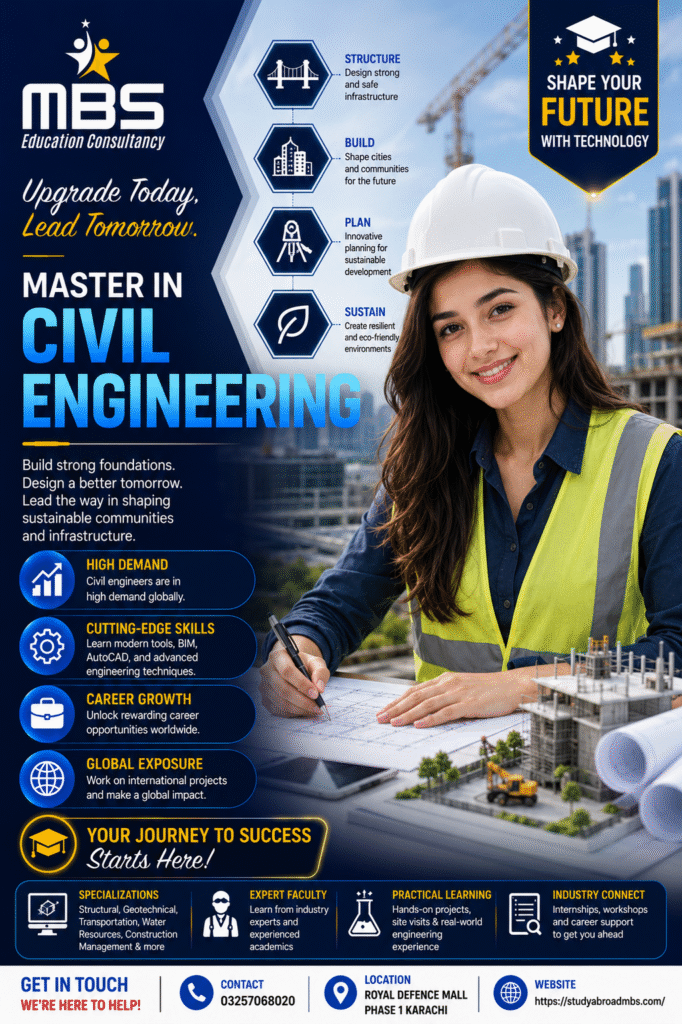
What is a Master in Civil Engineering?
A Master in Civil Engineering is an advanced postgraduate program that focuses on the planning, design, construction, management and maintenance of infrastructure and civil engineering projects.
Depending on the selected program, students may specialize in areas such as structural engineering, construction management, geotechnical engineering, transportation engineering, water resources, environmental engineering or other related fields.
The program is mainly suitable for students who already hold a Bachelor’s degree in Civil Engineering or a closely related engineering discipline.
Master in Civil Engineering in Malaysia – Quick Overview
| Category | Details |
| Program Name | Master in Civil Engineering |
| Degree Level | Master’s Degree |
| Study Destination | Malaysia |
| Intake | Multiple intakes may be available depending on institution |
| Typical Duration | Approximately 1 – 2 years |
| Typical Semesters | Approximately 3 – 4 semesters |
| Study Mode | Full-Time / Part-Time |
| Medium of Instruction | Mainly English |
| Previous Qualification | Bachelor’s Degree in Civil Engineering or related field |
| International Students | Yes |
| Pakistani Students | Eligible subject to admission requirements |
| Scholarships | Available for eligible students |
| Career Areas | Construction, Structural Engineering, Infrastructure, Transportation, Water and Environmental Engineering |
Why Study Civil Engineering in Malaysia?
Malaysia is an attractive destination for students interested in postgraduate engineering education.
Some of the main reasons students choose Malaysia include:
- Wide range of engineering programs
- English-medium education at many institutions
- Modern academic and engineering facilities
- Multicultural international learning environment
- Different specializations within civil engineering
- Public and private higher education options
- Competitive tuition fees compared with some other international destinations
- Opportunities to develop technical and research skills
- Exposure to modern construction and infrastructure practices
- Suitable options for international students
What Will You Study in a Master in Civil Engineering?
The exact subjects depend on the institution and chosen specialization.
Common areas of study may include:
| Subject Area | What Students Learn |
| Advanced Structural Engineering | Analysis and design of advanced structures |
| Structural Analysis | Behavior and analysis of structures |
| Construction Management | Planning and management of construction projects |
| Geotechnical Engineering | Soil, foundations and underground structures |
| Transportation Engineering | Roads, highways and transport systems |
| Water Resources Engineering | Water systems and resource management |
| Environmental Engineering | Environmental protection and engineering solutions |
| Construction Materials | Properties and applications of construction materials |
| Project Management | Planning, scheduling and managing projects |
| Advanced Concrete Technology | Modern concrete materials and applications |
| Research Methods | Engineering research and academic methods |
| Engineering Modelling | Computer-based engineering analysis |
| Dissertation / Project | Research or practical engineering project |
The subjects and curriculum vary according to the selected Master’s program.
Popular Civil Engineering Specializations
Students may find Master’s programs specializing in different areas of civil engineering.
| Specialization | Main Focus |
| Structural Engineering | Buildings, bridges and structural systems |
| Construction Management | Construction projects and management |
| Geotechnical Engineering | Soil, foundations and underground structures |
| Transportation Engineering | Roads, highways, railways and transport |
| Water Resources Engineering | Water supply, drainage and water systems |
| Environmental Engineering | Environmental protection and sustainability |
| Infrastructure Engineering | Large-scale infrastructure development |
| Project Management | Engineering project planning and management |
| Materials Engineering | Construction materials and technology |
| Highway Engineering | Road design, construction and maintenance |
Students should choose a specialization according to their previous Bachelor’s degree, interests and career plans.
Master in Civil Engineering Course Duration
The duration of a Master’s in Civil Engineering depends on the institution, program structure and study mode.
A full-time Master’s program may generally take around 1 to 2 years to complete.
Some coursework-based programs may be completed within a shorter period, while research-based programs can take longer depending on the research project and thesis requirements.
| Study Mode | Approximate Duration |
| Full-Time Coursework | 1 – 2 Years |
| Full-Time Research | 1.5 – 3 Years or more |
| Part-Time | 2 – 4 Years |
| Mixed Coursework/Research | May vary |
The exact duration should be confirmed according to the selected program.
How Many Intakes Are Available in Malaysia?
There is no single intake calendar for all Malaysian institutions.
Different institutions may offer different intakes for Master’s programs. Depending on the institution, students may find admission opportunities around different periods of the year.
| Intake Period | Availability |
| January | Available at some institutions |
| February/March | Available at some institutions |
| April | Available at some institutions |
| June | Available at some institutions |
| September/October | Common intake period at some institutions |
| November | Available at selected institutions |
For the 2026–2027 intake, students should confirm the exact intake date and application deadline of their selected Civil Engineering program.
International students are advised to start the admission process several months before the intended intake.
Master in Civil Engineering Tuition Fees in Malaysia 2026–2027
Tuition fees vary between institutions and programs.
The final cost may depend on:
- Institution
- Specialization
- Coursework or research structure
- Study mode
- Number of credits
- Program duration
- International student charges
- Registration and administrative fees
As a general planning estimate, international students may expect approximately:
RM 25,000 – RM 50,000+ for the complete Master’s program.
Some programs may have lower fees, while specialized or premium programs may cost more.
| Expense | Estimated Cost |
| Master’s Tuition Fee | RM 25,000 – RM 50,000+ |
| Application/Registration | May apply |
| Student Administration Charges | May apply |
| Insurance | Additional |
| Student Pass/Visa Charges | Additional |
| Books & Study Materials | Depends on student |
| Laboratory/Project Costs | May apply |
| Accommodation | Additional |
| Food & Transportation | Additional |
These are estimated planning figures. The actual tuition fee depends on the selected institution and program.
Cost of Living in Malaysia for International Students
Students should prepare a separate budget for their living expenses.
The cost of living depends on the city, accommodation, transportation and personal lifestyle.
| Expense | Approximate Monthly Budget |
| Accommodation | RM 500 – RM 1,500+ |
| Food | RM 500 – RM 1,000+ |
| Transportation | RM 100 – RM 300+ |
| Mobile/Internet | RM 50 – RM 150+ |
| Personal Expenses | RM 200 – RM 500+ |
Students living in major cities or choosing private accommodation may have higher expenses.
Total Estimated Budget for Master in Civil Engineering
When preparing a study budget, students should consider tuition fees as well as living and other expenses.
| Cost Category | Estimated Budget |
| Tuition Fee | RM 25,000 – RM 50,000+ |
| Accommodation | Additional |
| Food | Additional |
| Transportation | Additional |
| Student Pass/Visa | Additional |
| Insurance | Additional |
| Books & Study Materials | Additional |
| Personal Expenses | Additional |
| Air Ticket | Additional |
The total cost will depend on the duration of the program and the student’s lifestyle.
Admission Requirements for Master in Civil Engineering
Admission requirements vary between institutions.
Generally, students applying for a Master’s in Civil Engineering are expected to have a recognized Bachelor’s degree in Civil Engineering or a related field.
Some institutions may have specific CGPA, professional experience or subject requirements.
| Requirement | General Information |
| Previous Qualification | Recognized Bachelor’s Degree |
| Preferred Background | Civil Engineering or related engineering field |
| CGPA | Often around 2.50 or equivalent |
| Lower CGPA | May be considered under certain conditions |
| Work Experience | May be required for some programs |
| English Proficiency | Usually required for international students |
| Passport | Valid passport |
| Additional Assessment | May apply |
The exact entry requirements should always be checked for the selected program.
Can Pakistani Civil Engineering Graduates Apply?
Yes.
Pakistani students who have completed a recognized Bachelor’s degree in Civil Engineering may apply for suitable Master’s programs in Malaysia if they meet the institution’s requirements.
Depending on the specialization, students may also be considered if they have a closely related engineering qualification.
Possible academic backgrounds may include:
- Bachelor of Civil Engineering
- Bachelor of Civil Engineering Technology
- Structural Engineering
- Construction Engineering
- Environmental Engineering
- Infrastructure Engineering
- Other closely related engineering disciplines
The final eligibility decision depends on the institution.
English Language Requirements
Many Master’s programs for international students are delivered in English.
Students may therefore need to demonstrate English language proficiency.
Commonly accepted qualifications may include:
| English Test | General Guide |
| IELTS | Around 6.0 may be required |
| TOEFL | May be accepted |
| PTE | May be accepted |
| Other Recognized Tests | Depending on institution |
| Previous Education in English | Exemption may be possible in some cases |
The exact English language requirement varies between institutions and programs.
Documents Required for Pakistani Students
Pakistani students should prepare their documents before starting the admission process.
Common documents include:
- Valid Passport
- Passport-size Photograph
- Bachelor’s Degree Certificate
- Bachelor’s Academic Transcript
- English Language Certificate, if required
- Updated CV/Resume
- Statement of Purpose, if required
- Recommendation Letters, if required
- Work Experience Letter, if required
- Other Academic Certificates
- Financial Documents, where required
- Any additional documents requested by the institution
Some documents may need to be certified, attested, verified or translated according to the institution’s requirements.
Application Process for Pakistani Students
The general application process can be completed through the following stages.
Step 1 – Select a Civil Engineering Program
Choose a Master’s program according to your Bachelor’s qualification, preferred specialization, career goals and budget.
Step 2 – Check Eligibility
Review the academic, CGPA, English language and other admission requirements.
Step 3 – Prepare Documents
Prepare your passport, degree, transcript, photographs, CV and other required documents.
Step 4 – Submit the Application
Submit the completed application and supporting documents according to the institution’s application procedure.
Step 5 – Application Assessment
The institution reviews the student’s academic qualifications and documents. Some programs may require an interview or additional assessment.
Step 6 – Receive Offer Letter
If the application is successful, the student receives an admission or offer letter.
Step 7 – Complete Required Payments
Pay any applicable registration, deposit or other required fees.
Step 8 – Student Pass/Visa Process
Start the required student pass and visa process after receiving admission.
Step 9 – Medical and Immigration Requirements
Complete the required medical examination and other immigration formalities.
Step 10 – Travel to Malaysia
After receiving the necessary approval, arrange travel and accommodation.
Step 11 – University Registration
Complete final registration and orientation after arriving in Malaysia.
Student Visa Process for Malaysia
International students need the appropriate student pass/visa arrangements to study in Malaysia.
The general process involves:
| Stage | Process |
| 1 | Receive admission/offer letter |
| 2 | Submit student pass documents |
| 3 | Student pass processing |
| 4 | Receive applicable approval |
| 5 | Complete required medical procedures |
| 6 | Travel according to applicable requirements |
| 7 | Complete final immigration and registration formalities |
Visa and immigration requirements may change, so students should follow the latest requirements applicable to their nationality and institution.
Scholarships for Master in Civil Engineering in Malaysia
International students may find scholarship and tuition assistance opportunities for postgraduate study.
Scholarships may be offered by institutions, government programs or other educational organizations.
Possible scholarship categories include:
| Scholarship Type | Possible Support |
| Merit Scholarship | Based on academic performance |
| University Scholarship | Partial or other tuition support |
| International Student Scholarship | Support for eligible international students |
| Government Scholarship | May include tuition and allowances |
| Research Scholarship | May be available for eligible research students |
| Tuition Fee Discount | Reduction in tuition fees |
Scholarships are normally competitive and have specific eligibility requirements and deadlines.
Students should check available scholarship opportunities before finalising their financial plans.
Research-Based Master’s in Civil Engineering
Students interested in engineering research may choose a research-based Master’s program.
Research-based study normally involves selecting a research topic, conducting engineering research, collecting and analyzing data and preparing a thesis or dissertation.
Research areas may include:
- Structural Engineering
- Construction Technology
- Sustainable Construction
- Geotechnical Engineering
- Transportation Systems
- Water Resources
- Environmental Engineering
- Construction Materials
- Infrastructure Development
- Smart Cities
- Sustainable Infrastructure
Research programs can be particularly useful for students who plan to continue toward a PhD or pursue research and academic careers.
Career Opportunities After Master in Civil Engineering
A Master’s in Civil Engineering can help graduates develop advanced knowledge for careers in engineering, construction and infrastructure.
Possible career roles include:
- Civil Engineer
- Structural Engineer
- Construction Manager
- Project Manager
- Site Manager
- Structural Design Engineer
- Geotechnical Engineer
- Transportation Engineer
- Highway Engineer
- Water Resources Engineer
- Environmental Engineer
- Infrastructure Engineer
- Quantity Surveying-related Roles
- Engineering Consultant
- Project Planning Engineer
- Research Engineer
- Construction Consultant
Career opportunities depend on the student’s specialization, professional experience and applicable professional requirements.
Industries Where Civil Engineering Graduates Can Work
Graduates may find opportunities in industries such as:
- Construction
- Infrastructure Development
- Property Development
- Engineering Consultancy
- Transportation
- Roads and Highways
- Water Management
- Environmental Services
- Urban Development
- Structural Design
- Project Management
- Government Infrastructure
- Research and Development
- Building Services
Skills You Can Develop During a Master in Civil Engineering
During the Master’s program, students may develop advanced technical and professional skills such as:
- Structural Analysis
- Engineering Design
- Construction Management
- Project Planning
- Risk Management
- Engineering Research
- Data Analysis
- Problem Solving
- Technical Communication
- Project Management
- Sustainable Engineering
- Engineering Modelling
- Professional Decision Making
These skills can help graduates work on complex engineering and infrastructure projects.
Who Should Study a Master in Civil Engineering?
This program can be suitable for students who:
- Have a Bachelor’s degree in Civil Engineering
- Want to specialize in a particular civil engineering field
- Want to develop advanced engineering knowledge
- Are interested in construction and infrastructure
- Want to develop project management skills
- Want to pursue engineering research
- Plan to continue to PhD level
- Want to improve their professional qualifications
- Want international academic experience
Is a Master in Civil Engineering in Malaysia Suitable for Pakistani Students?
Yes. Pakistani students with a recognized Bachelor’s qualification in Civil Engineering or a related field can apply for suitable Master’s programs in Malaysia, subject to the admission requirements of the selected institution.
Students should carefully check their academic qualification, CGPA, English language requirements, tuition fees and intake dates before applying.
Important Things Pakistani Students Should Check Before Applying
Before choosing a Master’s program, students should check:
- Recognition of the institution and program
- Entry requirements
- Accepted Bachelor’s qualifications
- Minimum CGPA
- English language requirement
- Course duration
- Number of semesters
- Coursework or research structure
- Specialization options
- Total tuition fee
- Additional academic charges
- Intake dates
- Application deadlines
- Scholarship opportunities
- Student pass requirements
- Accommodation options
- Estimated living expenses
Students should also consider whether the selected program matches their intended professional career path.
Master in Civil Engineering in Malaysia 2026–2027 – Frequently Asked Questions
Is Master in Civil Engineering available for international students in Malaysia?
Yes. Malaysian higher education institutions offer postgraduate programs in Civil Engineering and related engineering fields for international students.
Can Pakistani students apply for a Master’s in Civil Engineering?
Yes. Pakistani Civil Engineering graduates can apply for suitable programs if they meet the admission requirements.
How long is a Master in Civil Engineering in Malaysia?
A full-time program may generally take around 1 to 2 years, while research-based programs can take longer depending on the research and thesis requirements.
How many semesters does the program have?
Many coursework-based programs may have approximately 3 to 4 semesters, although the exact structure varies.
What is the estimated tuition fee?
International students may generally plan for approximately RM 25,000 to RM 50,000+ for the complete program, depending on the institution and program.
Can I apply after a Bachelor’s in Civil Engineering from Pakistan?
Yes, provided your Bachelor’s qualification meets the admission requirements of the selected institution.
Can I choose Structural Engineering as a specialization?
Yes. Structural Engineering is one of the common areas available within postgraduate Civil Engineering education, although availability depends on the institution.
Is IELTS required?
Many programs require English language proficiency, but the exact requirement varies between institutions.
Is work experience required?
Some programs may require or prefer professional experience, while others may accept fresh graduates.
Can I study a research-based Master’s?
Yes. Research-based Master’s programs may be available for students interested in advanced engineering research and future PhD study.
Are scholarships available?
Scholarships and tuition assistance may be available for eligible international students. Availability and eligibility vary.
Are there multiple intakes?
Some institutions offer multiple intakes during the year, but the exact intake months vary by institution.
Is the program taught in English?
Many postgraduate programs for international students are taught in English.
Final Checklist for Pakistani Students
Before travelling to Malaysia for a Master in Civil Engineering, students should prepare:
- Valid passport
- Admission/offer letter
- Bachelor’s degree
- Academic transcripts
- English language certificate, if required
- Student pass/visa documents
- Required medical documents
- Accommodation arrangements
- Financial planning
- Travel arrangements
- Copies of important documents
- Personal essentials
Final Thoughts
A Master in Civil Engineering in Malaysia can be a valuable option for Pakistani engineering graduates who want to develop advanced technical knowledge and specialize in areas such as structural engineering, construction management, transportation, geotechnical engineering, water resources or infrastructure.
The program can provide students with opportunities to develop technical, analytical, research and project management skills that can be useful across the engineering and construction sectors.
For the 2026–2027 intake, students should start preparing their academic documents and financial plans early. Since tuition fees, admission requirements, intake dates, program structures and scholarship opportunities can vary between institutions, students should confirm the final requirements before applying.
With the right specialization and proper planning, a Master’s degree in Civil Engineering can help Pakistani students build a stronger academic and professional foundation for their future careers in engineering and infares