
Guide for Pakistani Students
Study Bachelor in Cyber Security in Malaysia
Cyber Security is one of the fastest-growing fields in the technology industry. As businesses, governments and organizations increasingly depend on digital systems, the need for skilled cyber security professionals continues to grow.
A Bachelor in Cyber Security prepares students to protect computer systems, networks, applications, databases and digital information from cyber threats.
Malaysia offers a range of technology and computing programs for international students. For Pakistani students interested in computers, technology, networking and digital security, Malaysia can be an attractive destination for studying Cyber Security.
This guide explains the admission requirements, duration, subjects, tuition fees, student pass, scholarships, living costs, career opportunities and application process for a Bachelor in Cyber Security in Malaysia.
What is a Bachelor in Cyber Security?
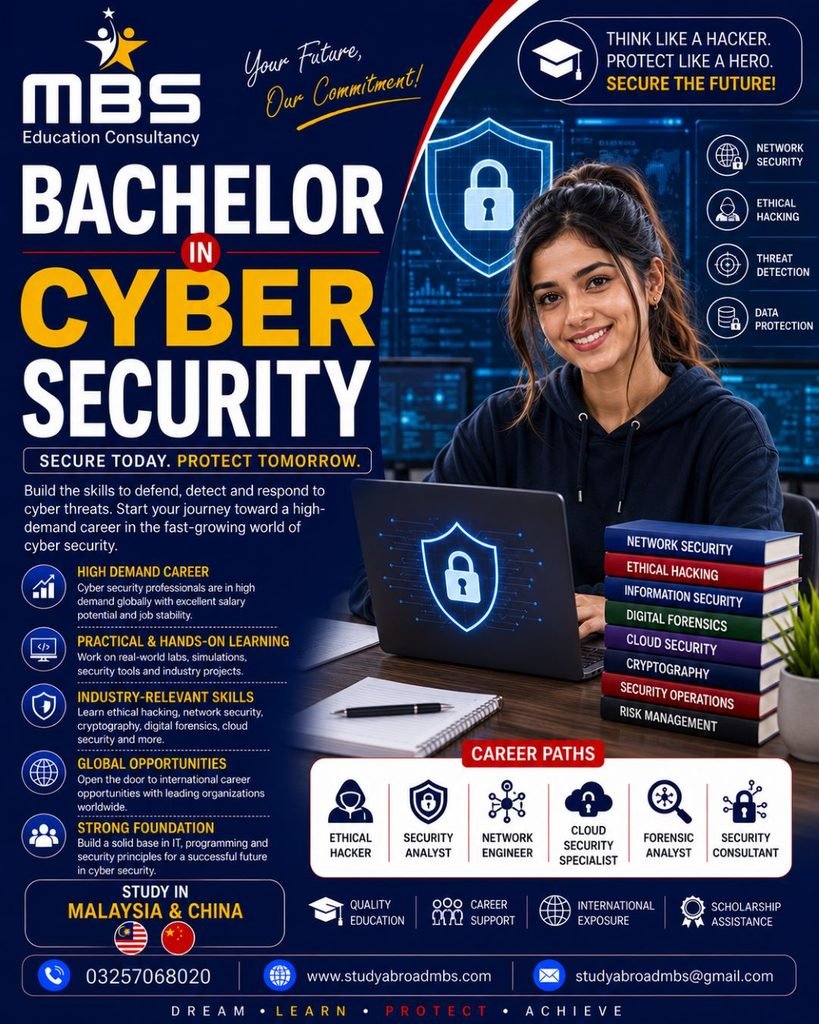
A Bachelor in Cyber Security is an undergraduate degree focused on protecting digital systems, networks, applications and information from cyber threats.
Students learn how to identify vulnerabilities, prevent attacks, investigate security incidents and develop secure digital systems.
The degree commonly covers:
- Cyber Security
- Computer Networks
- Information Security
- Ethical Hacking
- Digital Forensics
- Cryptography
- Network Security
- Secure Programming
- Risk Management
- Cybercrime
- Cloud Security
- Security Operations
Cyber Security combines technical knowledge with analytical thinking and problem-solving skills.
Why Study Cyber Security in Malaysia?
Malaysia can be a good option for students who want to study computing and cyber security in an international environment.
Main advantages include:
- Growing technology sector
- Modern computing facilities
- Practical and industry-focused education
- International student environment
- English-medium programs are widely available
- Opportunities for internships
- Affordable study options compared with many Western countries
- Exposure to modern cyber security technologies
- Opportunities for further study
- Growing demand for cyber security professionals
For Pakistani students, studying Cyber Security in Malaysia can provide international academic exposure and technical skills for a career in the growing digital security industry.
Who Can Apply?
Pakistani students who have completed Intermediate, FSc, A-Level or another recognised equivalent qualification may be eligible to apply.
Depending on the university, students from backgrounds such as:
- ICS
- FSc
- I.Com
- A-Level
- Relevant diploma qualifications
- Other recognized equivalent qualifications
may be considered.
The exact requirements depend on the selected university and program.
Academic Requirements for Pakistani Students
Admission requirements vary between universities.
Generally, students may need:
- Completed Intermediate, FSc, ICS, A-Level or equivalent qualification
- Acceptable academic results
- Mathematics or relevant computing subjects where required
- Valid passport
- English language proficiency where required
- Academic transcripts
- Other supporting documents requested by the university
Students should check the specific admission requirements before applying.
Duration of Bachelor in Cyber Security
A Bachelor in Cyber Security in Malaysia generally takes around:
3 to 4 years
The exact duration depends on the university and program structure.
Some programs may include:
- Industrial training
- Internship
- Security projects
- Laboratory work
- Final-year projects
What Will You Study in Cyber Security?
A Cyber Security degree covers many technical and security-related subjects.
Computer Networks
Students learn how computers and devices communicate and how networks can be protected.
Network Security
This focuses on protecting networks from unauthorized access, attacks and security threats.
Information Security
Students learn how to protect digital information and maintain its confidentiality, integrity and availability.
Ethical Hacking
Students learn authorized security testing techniques used to identify weaknesses in systems.
Digital Forensics
This area focuses on investigating digital evidence and analyzing security incidents.
Cryptography
Students learn how encryption and other security techniques are used to protect information.
Secure Programming
Students learn how to develop software while considering security vulnerabilities and secure coding practices.
Cybercrime
Students study different forms of cybercrime and methods used to investigate digital offences.
Security Management
This covers security policies, risk management and organizational security practices.
Cloud Security
Students learn about protecting cloud-based systems, applications and data.
Cyber security Operations
Students learn about monitoring systems, detecting threats and responding to security incidents.
Main Areas of Cyber Security
Cyber Security includes several specialized areas.
Network Security
Focuses on protecting computer networks, servers and communication systems.
Ethical Hacking
Focuses on authorized security testing and vulnerability assessment.
Digital Forensics
Deals with the investigation and analysis of digital evidence.
Application Security
Focuses on identifying and reducing security weaknesses in software and applications.
Cloud Security
Deals with protecting cloud infrastructure, services and digital data.
Incident Response
Focuses on detecting, analyzing and responding to cyber security incidents.
Cryptography
Uses mathematical techniques to protect information and secure communication.
Security Operations
Involves continuous monitoring, threat detection and security incident management.
Cyber Risk Management
Focuses on identifying security risks and developing strategies to reduce them.
Cyber Security vs Computer Science
Computer Science is a broad field covering programming, algorithms, software development, databases, artificial intelligence and computing systems.
Cyber Security focuses more specifically on protecting systems, networks, applications and information from cyber threats.
Students who want a specialized career in digital security may prefer Cyber Security.
Students who want a broader computing education with flexibility across many technology fields may choose Computer Science.
Cyber Security vs Information Technology
Information Technology focuses on implementing and managing computer systems, networks, software and IT infrastructure.
Cyber Security has a stronger focus on protecting these systems against cyber threats.
Both fields are closely connected, and IT knowledge can be very useful for cyber security professionals.
Intakes for 2026,2027
Different universities in Malaysia offer different intake schedules.
Common intake periods may include:
- January
- February
- May
- June
- September
- October
Not every university offers Cyber Security in every intake.
Students should check the available intake before submitting an application.
Admission Process for Pakistani Students
The general admission process usually involves the following steps:
Step 1: Choose a University
Select a Malaysian university offering a suitable Cyber Security program.
Step 2: Check Eligibility
Review the academic, subject and English language requirements.
Step 3: Prepare Documents
Collect your academic and personal documents.
Step 4: Submit Application
Complete the application and submit the required documents.
Step 5: Receive Offer Letter
If your application is successful, you may receive an offer letter.
Step 6: Accept the Offer
Follow the university’s instructions to accept your admission offer.
Step 7: Student Pass Process
Complete the required student pass and immigration procedures.
Step 8: Medical Screening
Complete any required medical examination.
Step 9: Arrange Accommodation and Travel
Prepare your accommodation and travel arrangements.
Step 10: Start Your Studies
Travel to Malaysia and begin your Cyber Security degree.
Documents Required
Pakistani students may generally need:
- Valid passport
- Passport-size photographs
- Matriculation certificate
- Intermediate/ICS/FSc certificate
- Academic transcripts
- English language certificate if required
- Completed application form
- Offer letter
- Other supporting documents requested by the university
All documents should be clear, accurate and properly prepared.
English Language Requirement
Many Cyber Security programs in Malaysia are taught in English.
Universities may require students to demonstrate English language proficiency depending on their admission policy.
Possible evidence may include:
- IELTS
- TOEFL
- Other recognized English language qualifications
- Previous English-medium education, where accepted
The exact requirement varies between universities.
Is IELTS Required for Cyber Security in Malaysia?
IELTS may be required by some universities, while others may accept alternative proof of English proficiency.
Students who have previously studied in English may sometimes be considered according to the university’s English language policy.
Students should confirm the exact requirement before applying.
Tuition Fees
Tuition fees for a Bachelor in Cyber Security vary depending on:
- University
- Program duration
- Campus
- Facilities
- Course structure
- International student fee structure
Malaysia can provide comparatively affordable options for international students compared with many Western study destinations.
Students should consider tuition fees together with living expenses and other university charges.
Additional University Costs
Apart from tuition fees, students may need to budget for:
- Application fees
- Registration fees
- Student services fees
- Laboratory fees
- Examination fees
- Student pass-related charges
- Medical screening
- Health insurance
- Accommodation
- Study materials
The exact costs depend on the university.
Student Pass for Pakistani Students
International students studying in Malaysia generally require the appropriate student pass or immigration approval.
After receiving an offer letter, students normally proceed with the required student pass process according to Malaysian education and immigration requirements.
Students should ensure that their passport and academic documents are valid and correctly prepared.
Medical Screening
International students may be required to complete medical screening as part of the student pass process.
Medical requirements and procedures can change, so students should follow the instructions provided by their university and relevant authorities.
Health Insurance
International students may need suitable health insurance during their studies.
Insurance requirements can depend on the university and applicable Malaysian regulations.
Students should confirm the required arrangements before travelling.
Scholarships for Cyber Security Students
Scholarship opportunities may be available for international students depending on the university and academic performance.
Possible scholarship opportunities may include:
- Merit-based scholarships
- Academic scholarships
- University scholarships
- Tuition fee discounts
- International student scholarships
Scholarship availability and eligibility can change from one intake to another.
Students with strong academic results should ask about available scholarship opportunities when applying.
How Much Scholarship Can a Student Get?
Scholarship amounts vary depending on the university and scholarship program.
Some scholarships may provide a percentage reduction in tuition fees rather than covering the entire cost of education.
Students should check:
- Scholarship eligibility
- Tuition fee reduction
- Academic conditions
- Renewal requirements
- Application deadline
Cost of Living in Malaysia
Living costs depend on the student’s city and lifestyle.
Main expenses may include:
- Accommodation
- Food
- Transportation
- Mobile and internet
- Study materials
- Personal expenses
- Entertainment
Students who manage their budget carefully can control their monthly expenses.
Accommodation for Students
Students can consider different accommodation options.
University Accommodation
On-campus accommodation can provide convenient access to classrooms, laboratories and other university facilities.
Private Accommodation
Students may rent rooms or apartments outside the campus.
Shared Accommodation
Sharing accommodation with other students can help reduce monthly housing costs.
Can Pakistani Students Work While Studying?
International students may be allowed to undertake limited part-time work under applicable Malaysian regulations and restrictions.
Students should not depend on part-time employment as their main source of financial support.
The primary purpose of a student pass is education, and students must follow all applicable rules and conditions.
Career Opportunities After Cyber Security
A Cyber Security degree can lead to a wide range of technology and security careers.
Graduates may work as:
- Cyber Security Analyst
- Information Security Analyst
- Security Operations Centre Analyst
- Network Security Engineer
- Cyber Security Engineer
- Security Engineer
- Penetration Testing Associate
- Ethical Hacking Specialist
- Digital Forensics Analyst
- Incident Response Analyst
- Security Consultant
- IT Security Specialist
- Vulnerability Assessment Analyst
- Application Security Analyst
- Cloud Security Associate
- Cyber Risk Analyst
- Security Administrator
- Security Operations Analyst
- Cyber Threat Analyst
- Information Security Consultant
Career opportunities depend on qualifications, practical skills, certifications and professional experience.
Industries Hiring Cyber Security Professionals
Cyber security professionals can work across many industries, including:
- Banking
- Financial Services
- Information Technology
- Telecommunications
- Government
- E-Commerce
- Healthcare
- Manufacturing
- Education
- Aviation
- Energy
- Retail
- Software Companies
- Technology Companies
- Consulting
- Cyber security Services
Almost every modern organization that uses digital systems requires some level of cyber security protection.
Skills Developed During the Degree
Students can develop important technical and professional skills, including:
- Network security
- Security analysis
- Vulnerability assessment
- Ethical hacking
- Digital forensics
- Cryptography
- Secure programming
- Risk assessment
- Incident response
- Security monitoring
- Problem-solving
- Critical thinking
- Research
- Communication
- Teamwork
Programming Skills for Cyber Security
Programming can be an important part of cyber security.
Students may learn programming and scripting languages used for automation, security testing and system analysis.
Commonly useful technologies may include:
- Python
- Java
- C/C++
- JavaScript
- SQL
- Bash
- PowerShell
The exact programming languages taught depend on the university and program structure.
Cyber Security Certifications
Professional certifications can complement a Cyber Security degree.
Depending on career goals, students may explore certifications related to:
- Network security
- Ethical hacking
- Security operations
- Cloud security
- Digital forensics
- Information security management
Certifications should be selected according to the student’s career path and level of experience.
Importance of Internship and Practical Training
Cyber Security is a highly practical field.
Students should gain hands-on experience through:
- Internships
- Cyber security laboratories
- Security projects
- Capture-the-Flag competitions
- Networking projects
- Digital forensics exercises
- Security research
- Final-year projects
Practical experience can help students understand real-world cybersecurity challenges and improve their technical abilities.
Building a Cyber Security Portfolio
Students can improve their career prospects by building a practical portfolio.
A portfolio may include:
- Cyber security projects
- Network security projects
- Security reports
- Vulnerability assessment exercises
- Programming projects
- Digital forensics case studies
- Security research
- Academic projects
Students should only perform security testing on systems where they have clear permission to do so.
Further Study After Bachelor in Cyber Security
After completing a Bachelor’s degree, students can continue their education in areas such as:
- Master in Cyber Security
- Master in Information Security
- Master in Information Technology
- Master in Computer Science
- Master in Digital Forensics
- Master in Network Security
- Master in Cloud Computing
- Master in Data Security
- Master in Artificial Intelligence
Students interested in research and academic careers can also consider doctoral-level studies after completing the relevant qualifications.
Is Cyber Security Suitable for ICS Students?
Yes. Cyber Security can be a strong choice for students with an ICS background.
ICS students may already have exposure to:
- Computer Science
- Programming
- Mathematics
- Information Technology
This background can provide a useful foundation for studying cybersecurity.
However, admission requirements vary between universities.
Can FSc Students Study Cyber Security?
Yes, FSc students may be eligible depending on the university’s admission requirements.
Students with Mathematics or relevant subjects may find the transition into computing and cyber security easier.
The exact eligibility criteria should be checked before applying.
Can I.Com or FA Students Study Cyber Security?
Eligibility depends on the university and program requirements.
Some institutions may accept students from broader academic backgrounds, while others may require Mathematics or specific computing-related subjects.
Students should check the individual university’s entry requirements before applying.
Is Cyber Security Difficult?
Cyber Security can be challenging because it combines:
- Computer networks
- Programming
- Operating systems
- Security concepts
- Mathematics
- Problem-solving
- Technical analysis
- Digital investigation
However, students who are interested in technology and are willing to practice regularly can develop the skills needed to succeed.
Cyber security is also a field where continuous learning is important because cyber threats and technologies continue to change.
Estimated First-Year Budget
The following is a general planning guide. Actual expenses vary according to the university, city and lifestyle.
| Expense | Estimated Cost |
| Tuition Fee | Depends on University |
| Registration/Application | Depends on University |
| Student Pass & Related Charges | Depends on Requirements |
| Medical & Insurance | Depends on Provider/University |
| Accommodation | Depends on Location |
| Food | Depends on Lifestyle |
| Transportation | Depends on Location |
| Study Materials | Depends on Requirements |
| Personal Expenses | Depends on Lifestyle |
Students should prepare a complete financial plan before travelling to Malaysia.
Common Mistakes Pakistani Students Should Avoid
1. Choosing Cyber Security Without Understanding the Field
Cyber Security requires technical learning, continuous practice and regular knowledge updates.
2. Ignoring Networking and Programming
Strong networking and programming fundamentals can be very useful for cybersecurity careers.
3. Focusing Only on Ethical Hacking
Cyber Security is much broader than ethical hacking. It also includes network security, digital forensics, cloud security, incident response and risk management.
4. Applying With Incomplete Documents
Missing documents can delay the admission process.
5. Looking Only at Tuition Fees
Consider accommodation, food, transportation, insurance and other expenses as well.
6. Not Getting Practical Experience
A degree combined with practical skills and experience can provide a stronger foundation for employment.
Application Checklist for Pakistani Students
Before applying, make sure you have:
- Valid passport
- Matriculation documents
- Intermediate/ICS/FSc documents
- Academic transcripts
- English language evidence if required
- Passport-size photographs
- Completed application form
- Required supporting documents
- Financial plan
- Accommodation plan
Step-by-Step Guide for Pakistani Students
Step 1
Complete your Intermediate, ICS, FSc, A-Level or equivalent qualification.
Step 2
Choose a suitable Bachelor in Cyber Security program in Malaysia.
Step 3
Check university eligibility and subject requirements.
Step 4
Prepare your academic and personal documents.
Step 5
Submit your application.
Step 6
Receive and accept the offer letter.
Step 7
Complete the required student pass and immigration procedures.
Step 8
Complete medical screening and insurance requirements.
Step 9
Arrange accommodation and travel.
Step 10
Travel to Malaysia and start your Cyber Security studies.
Why Choose Cyber Security?
Cyber Security is a strong option for students who are interested in:
- Computers
- Technology
- Networking
- Programming
- Digital security
- Ethical hacking
- Problem-solving
- Cyber investigations
- Cloud technology
- Modern digital systems
The field offers career opportunities across banking, technology, telecommunications, government, e-commerce, healthcare and many other industries.
Quick Facts
Program: Bachelor in Cyber Security
Study Destination: Malaysia
Intake: 2026–2027
Duration: Approximately 3–4 Years
Study Level: Undergraduate
Main Subjects: Network Security, Ethical Hacking, Digital Forensics, Cryptography, Secure Programming, Cybercrime, Cloud Security and Security Operations
Suitable Background: ICS, FSc, A-Level or other equivalent qualifications, depending on university requirements
Language: English is commonly used for instruction
Career Areas: Cyber Security, Information Security, Network Security, Digital Forensics, Security Operations, Cloud Security and Cyber Risk
Final Advice for Pakistani Students
If you are interested in computers, technology, networking and digital security, a Bachelor in Cyber Security can be a strong choice for your future.
Before applying, compare universities based on their curriculum, practical laboratories, internship opportunities, academic requirements, tuition fees and overall living costs.
Do not focus only on the degree. Start developing practical skills in networking, programming, operating systems and cyber security concepts alongside your studies.
The cyber security industry changes quickly, so continuous learning, practical experience and professional development can be important for long-term career growth.
Start Your Cyber Security Journey in Malaysia
A Bachelor in Cyber Security can provide students with technical knowledge, practical experience and security skills needed to protect modern digital systems.
For Pakistani students planning to study abroad in the 2026–2027 intake, Malaysia can be considered as an option for gaining an international education in a growing technology field.
Build your technical skills, develop practical experience and take the first step toward your Cyber Security career.