
Guide for Pakistani Students
Study Bachelor in Culinary Arts in Malaysia
If you have a passion for cooking, food, hospitality and creativity, a Bachelor in Culinary Arts can be an excellent choice for building an international career in the food and hospitality industry.
Malaysia is becoming an attractive destination for international students interested in culinary arts because of its multicultural food environment, growing hospitality industry and practical approach to culinary education.
For Pakistani students, studying Culinary Arts in Malaysia can provide an opportunity to develop professional cooking skills, learn international cuisines and gain practical experience in a multicultural environment.
This guide explains the admission requirements, duration, subjects, tuition fees, scholarships, living costs, student pass, career opportunities and application process for a Bachelor in Culinary Arts in Malaysia.
What is a Bachelor in Culinary Arts?
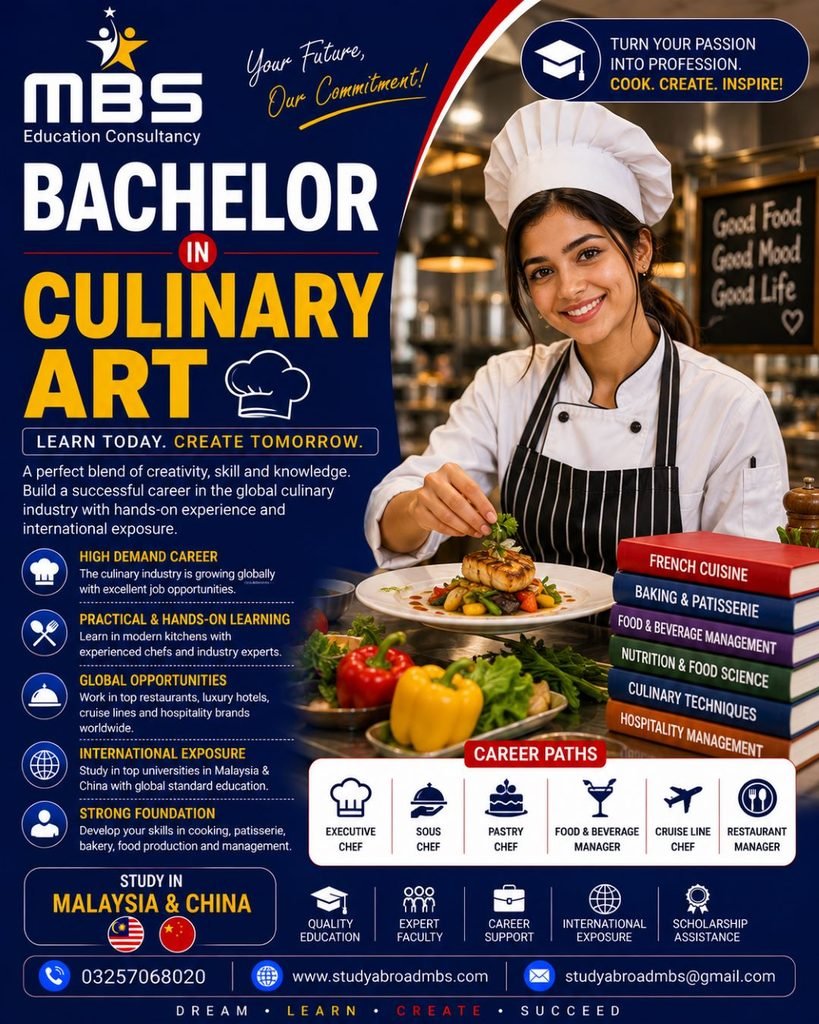
A Bachelor in Culinary Arts is an undergraduate degree focused on professional cooking, food preparation, kitchen management, food safety, menu development and hospitality operations.
The program combines practical culinary training with academic knowledge and business skills.
Students may learn about:
- Professional Cooking
- International Cuisine
- Food Preparation
- Baking and Pastry
- Food Safety
- Nutrition
- Menu Planning
- Kitchen Management
- Restaurant Operations
- Food Costing
- Hospitality Management
- Culinary Entrepreneurship
The degree can prepare students for careers in restaurants, hotels, resorts, catering companies, cruise lines, food businesses and other hospitality environments.
Why Study Culinary Arts in Malaysia?
Malaysia has a diverse food culture influenced by Malay, Chinese, Indian and international cuisines. This creates an interesting environment for students who want to explore different culinary traditions.
Main advantages include:
- Practical culinary education
- Professional kitchen training
- Exposure to different cuisines
- Multicultural food environment
- Growing hospitality and tourism industry
- Opportunities for internships
- International student environment
- English-medium programs are widely available
- Opportunities to develop business and management skills
- Potential career opportunities in the international hospitality industry
For Pakistani students who are passionate about food and hospitality, Malaysia can offer an interesting combination of education, practical training and cultural exposure.
Who Can Apply?
Pakistani students who have completed Intermediate, A-Level or another recognised equivalent qualification may be eligible to apply.
Students from different academic backgrounds may be considered depending on the university.
Possible qualifications include:
- Intermediate
- FA
- FSc
- I.Com
- A-Level
- Relevant diploma qualifications
- Other recognized equivalent qualifications
The exact admission requirements depend on the university and selected program.
Academic Requirements for Pakistani Students
Admission requirements can vary between universities.
Generally, students may need:
- Completed Intermediate or equivalent qualification
- Acceptable academic results
- Valid passport
- English language proficiency where required
- Academic transcripts
- Other supporting documents requested by the university
Some universities may also consider students with relevant culinary or hospitality diplomas for admission or credit transfer, depending on their academic policies.
Duration of Bachelor in Culinary Arts
A Bachelor in Culinary Arts in Malaysia generally takes around:
3 to 4 years
The exact duration depends on the university and program structure.
Some programs may include:
- Practical kitchen training
- Industry placements
- Internships
- Restaurant operations
- Final-year projects
What Will You Study in Culinary Arts?
A Culinary Arts degree combines practical cooking with hospitality, business and management knowledge.
Common subjects may include:
Professional Culinary Skills
Students learn professional cooking techniques, food preparation and kitchen procedures.
International Cuisine
Students explore different cuisines and cooking traditions from around the world.
Food Preparation
This covers ingredient selection, preparation techniques and professional food production.
Baking and Pastry
Students learn techniques for preparing breads, cakes, desserts, pastries and other baked products.
Food Safety and Hygiene
Students learn safe food handling, sanitation and professional kitchen hygiene.
Nutrition
Students develop an understanding of nutrients, healthy food preparation and dietary requirements.
Menu Planning
Students learn how to create menus based on customer preferences, ingredients, cost and restaurant concepts.
Food Cost Control
Students learn how to calculate ingredient costs, portion sizes and food pricing.
Kitchen Management
This focuses on managing kitchen operations, staff, equipment and food production.
Restaurant Management
Students learn about restaurant operations, customer service and hospitality management.
Culinary Entrepreneurship
Students learn how to develop and manage their own food-related business.
Main Areas of Culinary Arts
A Culinary Arts degree can cover several specialized areas.
Professional Cooking
Focuses on cooking techniques, food preparation and professional kitchen operations.
Baking and Pastry
Focuses on breads, pastries, cakes, desserts and other bakery products.
International Cuisine
Students learn about different culinary traditions and cooking techniques from around the world.
Food and Beverage Management
Focuses on restaurant operations, beverage services and hospitality management.
Culinary Management
Combines culinary skills with leadership, staff management and business operations.
Food Entrepreneurship
Focuses on developing and managing food businesses such as restaurants, bakeries, cafés and catering companies.
Food Product Development
Students explore new food concepts, recipes, presentation and product innovation.
Culinary Arts vs Hospitality Management
Culinary Arts focuses more on cooking, food preparation, kitchen operations, menu development and culinary techniques.
Hospitality Management has a broader focus that may include hotels, restaurants, tourism, events, customer service and business operations.
If you love cooking and want to develop professional culinary skills, Culinary Arts may be a better fit.
If you are more interested in managing hotels, resorts and wider hospitality operations, Hospitality Management may be more suitable.
Culinary Arts vs Hotel Management
Culinary Arts focuses heavily on food production and kitchen operations.
Hotel Management covers wider hotel operations, including:
- Front office
- Housekeeping
- Food and beverage
- Guest services
- Hotel administration
- Hospitality management
Students interested specifically in professional cooking may prefer Culinary Arts.
Intakes for 2026–2027
Different universities and culinary institutions in Malaysia may offer different intake periods.
Common intake periods may include:
- January
- February
- May
- June
- September
- October
Not every university offers Culinary Arts in every intake.
Students should check the available intake before submitting an application.
Admission Process for Pakistani Students
The general admission process usually involves the following steps:
Step 1: Choose a University
Select a suitable Malaysian university offering a Bachelor in Culinary Arts.
Step 2: Check Eligibility
Review the academic and English language requirements.
Step 3: Prepare Documents
Collect your academic and personal documents.
Step 4: Submit Application
Complete the application and submit the required documents.
Step 5: Receive Offer Letter
If your application is successful, you may receive an offer letter.
Step 6: Accept the Offer
Follow the university’s instructions to accept your admission offer.
Step 7: Student Pass Process
Complete the required student pass and immigration procedures.
Step 8: Medical Screening
Complete any required medical examination.
Step 9: Arrange Accommodation and Travel
Prepare your accommodation and travel arrangements.
Step 10: Start Your Culinary Studies
Travel to Malaysia and begin your Culinary Arts degree.
Documents Required
Pakistani students may generally need:
- Valid passport
- Passport-size photographs
- Matriculation certificate
- Intermediate certificate
- Academic transcripts
- English language certificate if required
- Completed application form
- Offer letter
- Other supporting documents requested by the university
Students should make sure that all documents are clear, accurate and properly prepared.
English Language Requirement
Many Culinary Arts programs in Malaysia use English for teaching and communication.
Universities may require students to demonstrate English language proficiency depending on their admission policy.
Possible evidence may include:
- IELTS
- TOEFL
- Other recognized English language qualifications
- Previous English-medium education, where accepted
The exact requirement can vary between universities.
Is IELTS Required for Culinary Arts in Malaysia?
IELTS may be required by some universities, while others may accept alternative proof of English proficiency.
Students who have previously studied in English may sometimes be considered according to the university’s policy.
It is important to confirm the English language requirement before applying.
Tuition Fees
Tuition fees for a Bachelor in Culinary Arts vary depending on:
- University
- Program duration
- Campus
- Culinary facilities
- Course structure
- Practical training
- International student fee structure
Students should compare the complete cost of the program before making a final decision.
Additional University Costs
Apart from tuition fees, students may need to budget for:
- Application fees
- Registration fees
- Student services fees
- Kitchen and practical fees
- Uniforms
- Chef coats
- Culinary equipment
- Ingredients
- Examination fees
- Student pass-related charges
- Medical screening
- Health insurance
- Accommodation
Culinary students should pay particular attention to practical training costs because ingredients, uniforms and kitchen equipment may be additional expenses.
Student Pass for Pakistani Students
International students studying in Malaysia generally require the appropriate student pass or immigration approval.
After receiving an offer letter, students normally proceed with the required student pass process according to Malaysian education and immigration requirements.
Students should ensure that their passport and academic documents are valid and correctly prepared.
Medical Screening
International students may be required to complete medical screening as part of the student pass process.
Medical requirements can change, so students should follow the instructions provided by their university and relevant authorities.
Health Insurance
International students may need suitable health insurance during their studies.
Insurance requirements can depend on the university and applicable Malaysian regulations.
Students should confirm the required arrangements before travelling to Malaysia.
Scholarships for Culinary Arts Students
Scholarship opportunities may be available depending on the university and the student’s academic performance.
Possible opportunities may include:
- Merit-based scholarships
- Academic scholarships
- University scholarships
- Tuition fee discounts
- International student scholarships
Scholarship availability and eligibility can vary from one intake to another.
How Much Scholarship Can a Student Get?
The scholarship amount or tuition fee reduction depends on the university and scholarship program.
Some scholarships may cover a percentage of tuition fees rather than the complete cost of education.
Students should check:
- Scholarship eligibility
- Tuition fee reduction
- Academic conditions
- Renewal requirements
- Application deadline
Cost of Living in Malaysia
The cost of living depends on the student’s city, accommodation and lifestyle.
Main expenses may include:
- Accommodation
- Food
- Transportation
- Mobile and internet
- Study materials
- Personal expenses
- Entertainment
Students can manage their monthly expenses by preparing a realistic budget.
Accommodation for Culinary Arts Students
Students can consider different accommodation options.
University Accommodation
On-campus accommodation can provide convenient access to university facilities.
Private Accommodation
Students may rent rooms or apartments near their campus.
Shared Accommodation
Sharing accommodation with other students can help reduce monthly housing costs.
Can Pakistani Students Work While Studying?
International students may be allowed to undertake limited part-time work under applicable Malaysian regulations and restrictions.
Students should not depend on part-time employment as their primary source of financial support.
The main purpose of a student pass is education, and students must follow all applicable rules and conditions.
Career Opportunities After Culinary Arts
A Bachelor in Culinary Arts can open career opportunities in professional kitchens, hotels, restaurants, catering companies and food businesses.
Graduates may work as:
- Chef
- Commis Chef
- Sous Chef
- Pastry Chef
- Bakery Chef
- Culinary Instructor
- Food Production Supervisor
- Kitchen Manager
- Restaurant Manager
- Food and Beverage Supervisor
- Catering Manager
- Food Product Developer
- Private Chef
- Personal Chef
- Culinary Consultant
- Food Entrepreneur
- Restaurant Entrepreneur
- Food Stylist
- Recipe Developer
Career progression depends on practical experience, culinary skills, qualifications and professional development.
Industries Hiring Culinary Arts Graduates
Graduates can work in:
- Hotels
- Restaurants
- Resorts
- Cafés
- Bakeries
- Catering Companies
- Cruise Lines
- Food Production
- Event Catering
- Hospitality Companies
- Food Businesses
- Private Catering
- Culinary Education
- Tourism Industry
Skills Developed During the Degree
Students can develop important practical and professional skills, including:
- Cooking techniques
- Food preparation
- Baking and pastry
- Food presentation
- Menu planning
- Food safety
- Kitchen management
- Food costing
- Inventory management
- Leadership
- Teamwork
- Communication
- Creativity
- Time management
- Customer service
- Business management
Practical Training and Internship
Practical training is one of the most important parts of culinary education.
Students may gain experience through:
- Professional kitchen training
- Restaurant operations
- Hotel internships
- Catering projects
- Food production
- Baking and pastry training
- Culinary competitions
- Industry placements
- Final-year projects
Practical experience can help students build confidence and develop professional kitchen skills.
Culinary Equipment and Uniforms
Culinary students may need professional equipment and clothing for practical classes.
Depending on the institution, students may require:
- Chef coat
- Chef trousers
- Safety shoes
- Chef hat
- Apron
- Knives
- Measuring equipment
- Other kitchen tools
Requirements vary between universities and institutions.
Students should check the required equipment list before starting the program.
Starting Your Own Food Business
A Culinary Arts degree can also provide a foundation for entrepreneurship.
Graduates may start businesses such as:
- Restaurant
- Café
- Bakery
- Catering company
- Dessert business
- Food delivery business
- Food truck
- Private chef service
- Event catering
- Food product business
Business success depends on food quality, customer service, marketing, financial management and effective operations.
Further Study After Bachelor in Culinary Arts
After completing a Bachelor’s degree, students can continue their education in areas such as:
- Master in Hospitality Management
- Master in Tourism Management
- Master in Food and Beverage Management
- Master in Business Administration
- Master in Hospitality Business
- Master in Culinary Management
- Master in Food Studies
Further education can be useful for students interested in management, education, research or entrepreneurship.
Is Culinary Arts Suitable for Pakistani Students?
Yes. Culinary Arts can be suitable for Pakistani students who have a genuine interest in cooking, food, hospitality and creative work.
The program is not limited to professional cooking. Students can also develop management, business and entrepreneurship skills.
Students who want to build careers in hotels, restaurants, resorts, catering or food businesses can consider this field.
Is Culinary Arts Difficult?
Culinary Arts can be challenging in a different way from traditional academic degrees.
Students may need to handle:
- Long practical sessions
- Kitchen pressure
- Time management
- Multiple food preparations
- Food safety requirements
- Recipe accuracy
- Teamwork
- Physical activity
- Professional kitchen discipline
Students who are passionate about cooking and willing to practice regularly can develop strong professional skills.
Estimated First-Year Budget
The following is a general planning guide. Actual costs vary according to the university, city and lifestyle.
| Expense | Estimated Cost |
| Tuition Fee | Depends on University |
| Registration/Application | Depends on University |
| Student Pass & Related Charges | Depends on Requirements |
| Medical & Insurance | Depends on Provider/University |
| Culinary Uniform & Equipment | Depends on Requirements |
| Ingredients & Practical Costs | Depends on Program |
| Accommodation | Depends on Location |
| Food | Depends on Lifestyle |
| Transportation | Depends on Location |
| Personal Expenses | Depends on Lifestyle |
Students should prepare a complete financial plan before travelling to Malaysia.
Common Mistakes Pakistani Students Should Avoid
1. Choosing Culinary Arts Without Understanding the Career
Students should understand that professional culinary careers require practical training, discipline and experience.
2. Ignoring Practical Costs
Uniforms, equipment and ingredients may create additional expenses.
3. Choosing a Program Only Because You Like Cooking
Professional kitchens can be demanding. Students should be prepared for practical work and long hours.
4. Applying With Incomplete Documents
Missing documents can delay the admission process.
5. Looking Only at Tuition Fees
Accommodation, food, transportation, practical expenses and other costs should also be considered.
6. Not Taking Internship Seriously
Industry experience can be extremely valuable for culinary careers.
Application Checklist for Pakistani Students
Before applying, make sure you have:
- Valid passport
- Matriculation documents
- Intermediate documents
- Academic transcripts
- English language evidence if required
- Passport-size photographs
- Completed application form
- Required supporting documents
- Financial plan
- Accommodation plan
Step-by-Step Guide for Pakistani Students
Step 1
Complete your Intermediate, A-Level or equivalent qualification.
Step 2
Choose a suitable Bachelor in Culinary Arts program in Malaysia.
Step 3
Check university eligibility and English language requirements.
Step 4
Prepare your academic and personal documents.
Step 5
Submit your application.
Step 6
Receive and accept the offer letter.
Step 7
Complete the required student pass and immigration procedures.
Step 8
Complete medical screening and insurance requirements.
Step 9
Prepare your culinary uniform and required equipment.
Step 10
Arrange accommodation and travel.
Step 11
Travel to Malaysia and begin your Culinary Arts studies.
Why Choose Culinary Arts?
Culinary Arts can be a great choice for students who enjoy:
- Cooking
- Food
- Creativity
- Baking
- International cuisines
- Hospitality
- Restaurants
- Hotels
- Entrepreneurship
- Working in professional kitchens
The field offers different career paths, from professional chef roles to restaurant management and food entrepreneurship.
Quick Facts
Program: Bachelor in Culinary Arts
Study Destination: Malaysia
Intake: 2026–2027
Duration: Approximately 3–4 Years
Study Level: Undergraduate
Main Subjects: Professional Cooking, International Cuisine, Baking and Pastry, Food Safety, Menu Planning, Food Costing, Kitchen Management and Restaurant Operations
Suitable Background: Intermediate, FA, FSc, I.Com, A-Level or equivalent qualifications, depending on university requirements
Language: English is commonly used for instruction
Career Areas: Hotels, Restaurants, Resorts, Catering, Bakeries, Food Businesses, Cruise Lines and Hospitality
Final Advice for Pakistani Students
If you have a genuine passion for cooking, food and hospitality, a Bachelor in Culinary Arts can be an exciting career path.
Before applying, compare universities based on their practical kitchens, course structure, internship opportunities, tuition fees, additional culinary costs and overall living expenses.
Remember that success in the culinary industry depends not only on your degree but also on practical skills, creativity, discipline and professional experience.
Start building your culinary skills from the beginning, take internships seriously and continue learning about international cuisines and modern food trends.
Start Your Culinary Arts Journey in Malaysia
A Bachelor in Culinary Arts can provide students with professional cooking skills, hospitality knowledge, management experience and entrepreneurial skills.
For Pakistani students planning to study abroad in the 2026–2027 intake, Malaysia can be considered as an option for gaining international culinary and hospitality education in a multicultural environment.
Follow your passion for food, develop your professional skills and take the first step toward your culinary career.