Guide for Pakistani Students
Introduction
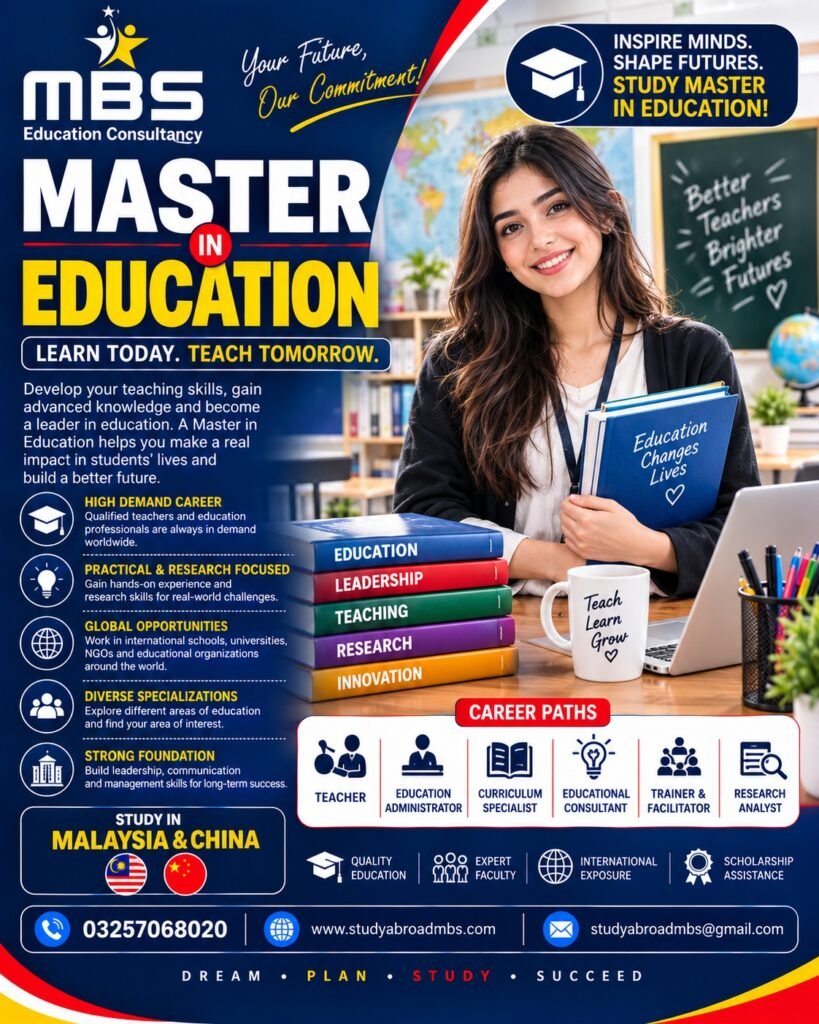
A Master in Education (M.Ed.) is a postgraduate degree designed for teachers, education professionals and graduates who want to develop advanced knowledge in teaching, educational leadership, curriculum development, educational psychology, research and modern learning methods.
The program can help students build professional skills for careers in schools, colleges, universities, educational organizations, training institutions and education-related management.
For Pakistani students planning to study in Malaysia during the 2026–2027 intake, a Master’s in Education can be a suitable option for those who want to advance their teaching career, move into educational leadership or specialize in a particular area of education.
What Is a Master in Education?
A Master in Education focuses on advanced theories, practices and research related to education and learning.
Depending on the university and specialization, students may study areas such as:
- Educational Leadership
- Curriculum and Instruction
- Educational Psychology
- Teaching and Learning
- Educational Technology
- Assessment and Evaluation
- Educational Management
- Early Childhood Education
- Special Education
- Higher Education
- Guidance and Counselling
- Education Research
- Language Education
The program may be offered through coursework, mixed mode or research, depending on the institution.
Quick Overview
| Category | Details |
|---|---|
| Program | Master in Education |
| Study Level | Postgraduate / Master’s Degree |
| Destination | Malaysia |
| Intake | 2026–2027 |
| Typical Duration | 1–2 Years |
| Study Mode | Full-Time / Part-Time |
| Medium of Instruction | English |
| Estimated Tuition Fee | RM 20,000 – RM 45,000+ |
| Academic Background | Education or Related Bachelor’s Degree |
| International Students | Yes |
| Main Career Areas | Teaching, Education Management, Leadership, Research |
Why Study Education in Malaysia?
Quality Higher Education
Malaysia has a well-developed higher education sector with postgraduate programs covering different areas of education and educational research.
International Learning Environment
International students can experience a multicultural academic environment and interact with students and educators from different backgrounds.
English-Medium Study Options
Many programs designed for international students use English as the main language of instruction.
Affordable Study Destination
Malaysia can be a comparatively affordable option for international students when tuition and living expenses are considered together.
Professional Development
A Master’s in Education can help experienced teachers and education professionals develop advanced knowledge and prepare for leadership or specialist roles.
What Will You Study?
The subjects depend on the university and chosen specialization.
Common areas include:
| Study Area | Possible Subjects |
|---|---|
| Education | Contemporary Issues in Education |
| Teaching | Advanced Teaching and Learning |
| Research | Educational Research Methods |
| Psychology | Educational Psychology |
| Curriculum | Curriculum Development |
| Assessment | Educational Assessment and Evaluation |
| Leadership | Educational Leadership |
| Management | Education Management |
| Technology | Educational Technology |
| Learning | Learning Theories |
| Policy | Education Policy |
| Research Project | Dissertation or Research Project |
Popular Specializations
Students may choose from different education-related areas, depending on the university.
Popular options include:
- Educational Leadership
- Educational Management
- Curriculum and Instruction
- Educational Technology
- Educational Psychology
- Early Childhood Education
- Special Education
- TESOL and Language Education
- Higher Education
- Guidance and Counselling
- Assessment and Evaluation
- Teaching and Learning
- Education Policy
- Adult Education
- STEM Education
Duration of the Program
The duration depends on the university and study structure.
| Program Type | Typical Duration |
|---|---|
| Full-Time Coursework | Around 1–2 Years |
| Mixed Mode | Around 1.5–2 Years |
| Research-Based | Around 2 Years or More |
| Part-Time | Usually Longer |
Students should confirm the exact duration before applying because requirements can vary between institutions.
Intakes in Malaysia
Intake periods vary by university and program.
Common intake periods may include:
- January
- February/March
- May/June
- September/October
Students planning for the 2026–2027 intake should check the intake schedule of their selected program and prepare their application in advance.
Estimated Tuition Fees
Tuition fees vary according to the institution, specialization and program structure.
| Expense | Estimated Cost |
|---|---|
| Master’s Tuition Fee | RM 20,000 – RM 45,000+ |
| Application/Registration Charges | Varies |
| Student Visa/Related Charges | Varies |
| Insurance | Varies |
| Research/Study Expenses | Varies |
These figures are general estimates for planning purposes. Actual fees can differ between institutions.
Cost of Living in Malaysia
Monthly living expenses depend on the city, accommodation and lifestyle.
| Expense | Estimated Monthly Cost |
|---|---|
| Accommodation | RM 500 – RM 1,200 |
| Food | RM 500 – RM 900 |
| Transportation | RM 100 – RM 300 |
| Mobile/Internet | RM 50 – RM 150 |
| Personal Expenses | RM 200 – RM 400 |
| Approximate Total | RM 1,350 – RM 2,950 |
Students choosing private accommodation or living in more expensive areas may have higher monthly expenses.
Estimated Total Study Budget
Students should consider tuition fees as well as living and other study-related expenses.
| Budget Category | Estimated Range |
|---|---|
| Tuition Fee | RM 20,000 – RM 45,000+ |
| Living Expenses | RM 16,000 – RM 30,000+ per year |
| Visa, Insurance & Other Costs | Varies |
| Books & Academic Expenses | Varies |
| Overall Budget | Depends on University and Lifestyle |
Admission Requirements
Typical admission requirements may include:
- A recognized bachelor’s degree
- Academic transcripts
- Degree certificate
- English language proficiency
- Valid passport
- Updated CV
- Personal statement or study plan, if required
- Recommendation letters, if required
- Teaching or professional experience, where applicable
Some specialized programs may have additional requirements.
Eligibility for Pakistani Students
Pakistani students can apply if they meet the admission requirements of the selected institution.
Relevant academic backgrounds may include:
- Bachelor of Education
- Bachelor of Arts in Education
- Bachelor of Early Childhood Education
- Bachelor of Teaching
- Bachelor of English or Language Studies
- Bachelor of Psychology
- Bachelor of Social Sciences
- Other relevant bachelor’s degrees
Some universities may also consider applicants from other academic backgrounds, depending on the program and professional experience.
English Language Requirements
International students may need to demonstrate English language proficiency.
| Test | Typical Requirement |
|---|---|
| IELTS | Around 6.0, depending on university |
| TOEFL | University dependent |
| Other Accepted Tests | Depending on institution |
| Alternative English Evidence | May be accepted in some cases |
Exact requirements depend on the selected program and university.
Teaching Experience
Teaching experience is not necessarily required for every Master in Education program.
However, some programs or specializations may prefer or require professional experience, particularly those focused on:
- Educational Leadership
- Education Management
- School Administration
- Professional Teaching
- Educational Policy
Students should check the specific admission criteria before applying.
Documents Required
Pakistani students should normally prepare:
- Valid Passport
- Bachelor’s Degree Certificate
- Academic Transcripts
- Passport-size Photograph
- Updated CV
- English Language Certificate, if required
- Personal Statement or Study Plan, if required
- Recommendation Letters, if required
- Employment or Teaching Experience Documents, if applicable
- Other documents requested by the university
All documents should be properly prepared and submitted according to the institution’s requirements.
Application Process
Step 1 – Choose Your Specialization
Decide whether you want to focus on educational leadership, teaching, curriculum, educational technology, psychology or another area.
Step 2 – Check Eligibility
Review academic qualifications, English requirements and any professional experience requirements.
Step 3 – Prepare Documents
Prepare your passport, degree, transcripts, CV and other required documents.
Step 4 – Submit Your Application
Complete the application and submit the required documents.
Step 5 – Receive the Offer Letter
If your application is successful, the institution may issue an offer or admission letter.
Step 6 – Accept the Offer
Follow the university’s instructions to accept your place and complete the required formalities.
Step 7 – Student Visa Process
Begin the required Malaysian student pass and visa procedures.
Step 8 – Travel to Malaysia
After receiving the necessary approval, arrange your travel and accommodation.
Step 9 – University Registration
Complete registration and orientation after arriving in Malaysia.
Student Visa Process for Pakistani Students
International students need the appropriate Malaysian student pass and visa arrangements before starting their studies.
The general process includes:
- University admission
- Student pass application
- Submission of required documents
- Immigration procedures
- Medical and insurance requirements, where applicable
- Visa approval
- Travel arrangements
- University registration after arrival
Visa procedures and requirements can change, so students should follow the latest instructions applicable to their admission.
Scholarships and Financial Support
International students may have access to different scholarship and financial-support opportunities.
Possible options include:
- University scholarships
- Merit-based scholarships
- Tuition fee discounts
- Research funding
- Postgraduate financial assistance
- Government or institutional scholarship schemes
Scholarship availability, eligibility and deadlines vary between institutions.
Research-Based Master in Education
Students interested in educational research or future PhD studies can consider a research-based Master’s in Education where available.
Possible research areas include:
- Educational Technology
- Curriculum Development
- Educational Psychology
- Teacher Education
- Higher Education
- Early Childhood Education
- Special Education
- Language Education
- Educational Leadership
- Education Policy
- Online Learning
- Assessment and Evaluation
- Inclusive Education
- STEM Education
Research students may need to prepare a research proposal and work under the supervision of an academic researcher.
Career Opportunities After Master in Education
Graduates can pursue different careers depending on their previous experience, specialization and professional qualifications.
Potential career roles include:
- Teacher
- Senior Teacher
- Education Coordinator
- Academic Coordinator
- School Administrator
- Education Manager
- Academic Manager
- Curriculum Specialist
- Education Consultant
- Instructional Designer
- Educational Technology Specialist
- Training and Development Specialist
- Education Researcher
- Academic Advisor
- Student Support Specialist
- Education Program Coordinator
Some teaching and administrative positions may require additional professional qualifications or local licensing.
Industries and Work Areas
Education graduates can work in:
- Schools
- Colleges
- Universities
- Training Centers
- Educational Organizations
- EdTech Companies
- Government Education Departments
- Non-Governmental Organizations
- Corporate Training
- Educational Research
- Private Education
- Online Learning
- International Education
Skills You Can Develop
Academic and Professional Skills
- Educational research
- Curriculum development
- Teaching strategies
- Assessment design
- Educational planning
- Leadership
- Classroom management
- Academic writing
- Education policy analysis
Modern Education Skills
- Digital learning
- Online teaching
- Learning management systems
- Instructional design
- Educational technology
- Digital assessment
- Student engagement
Professional Skills
- Communication
- Leadership
- Problem solving
- Critical thinking
- Teamwork
- Project management
- Research and analysis
Is Master in Education Suitable for Pakistani Students?
Yes. A Master’s in Education can be a suitable choice for Pakistani students who want to develop their professional knowledge and progress in the education sector.
It can be particularly useful for students who want to:
- Advance their teaching career
- Move into educational leadership
- Specialise in educational technology
- Work in curriculum development
- Enter education management
- Develop research skills
- Work in international education
- Prepare for PhD studies
Who Should Study This Degree?
A Master in Education may be suitable for:
- Teachers
- Education graduates
- School administrators
- Academic coordinators
- Education professionals
- Trainers
- Education consultants
- Curriculum specialists
- Education researchers
- Graduates interested in educational leadership
- Professionals interested in educational technology
Important Things to Check Before Applying
Before selecting a university, students should carefully check:
- University recognition
- Program curriculum
- Specialization options
- Tuition fees
- Program duration
- Available intake
- Admission requirements
- English requirements
- Teaching experience requirements
- Coursework or research options
- Dissertation requirements
- Scholarship opportunities
- Accommodation
- Total study budget
- Student visa requirements
- Career relevance of the program
Frequently Asked Questions
Is Master in Education available in Malaysia?
Yes. Malaysian universities offer postgraduate programs in Education and related fields with different specializations.
How long does a Master’s in Education take?
A full-time program commonly takes around 1 to 2 years, depending on the university and program structure.
What is the estimated tuition fee?
International students should generally plan for approximately RM 20,000 to RM 45,000 or more, although actual fees vary between institutions.
Can Pakistani students apply for a Master’s in Education in Malaysia?
Yes. Pakistani students can apply if they meet the academic and other admission requirements.
Do I need a Bachelor of Education?
Not always. Some programs may accept graduates from related fields, depending on the university and specialization.
Is IELTS required?
It may be required for international students. Some institutions may accept alternative evidence of English proficiency.
Do I need teaching experience?
Not necessarily. Requirements depend on the university and the selected specialization. Leadership or professional education programs may have additional experience requirements.
Can I study Educational Technology?
Yes. Educational Technology is a common area of postgraduate study, although availability depends on the selected institution.
Can I continue to a PhD after a Master’s in Education?
Yes. Graduates can potentially continue to PhD-level study in Education, Educational Leadership, Educational Psychology, Curriculum Studies or related fields, subject to admission requirements.
Can I work while studying in Malaysia?
International student work permissions are subject to Malaysian immigration rules and the conditions applicable to international students. Students should check the current rules before making employment plans.
Can I become a teacher in Malaysia after completing this degree?
A master’s degree alone does not automatically provide teaching licensure or employment eligibility. Teaching requirements depend on the type of institution, position and applicable professional regulations.
Final Checklist for Pakistani Students
Before applying for the 2026–2027 intake, make sure you have:
☑ Valid passport
☑ Bachelor’s degree
☑ Academic transcripts
☑ English language evidence
☑ Updated CV
☑ Personal statement/study plan, if required
☑ Recommendation letters, if required
☑ Teaching or professional experience documents, if applicable
☑ Financial plan
☑ Admission documents
☑ Student visa/pass documents
Final Thoughts
A Master in Education in Malaysia can be a valuable option for teachers, education graduates and professionals who want to develop advanced knowledge in teaching, leadership, curriculum development, educational technology or research.
The degree can support career development in schools, colleges, universities, training organizations, educational companies and research environments.
For Pakistani students, Malaysia can provide an international learning environment with comparatively manageable tuition and living costs.
Before applying for the 2026–2027 intake, students should compare the curriculum, specializations, tuition fees, admission requirements, program duration, research options and overall study budget of different programs.
The best Master’s in Education program is one that matches your previous education, professional experience and long-term career goals.