Guide for Pakistani Students
Introduction
Artificial Intelligence is one of the fastest-growing areas of technology, with applications in business, healthcare, finance, education, manufacturing, cybersecurity, transportation and many other industries.
A Master in Artificial Intelligence (AI) is a postgraduate degree designed for students who want to develop advanced knowledge in artificial intelligence, machine learning, data analysis, intelligent systems and modern computing technologies.
For Pakistani students planning to study in Malaysia during the 2026–2027 intake, a Master’s in Artificial Intelligence can be a strong choice for developing advanced technical skills and preparing for careers in the global technology industry.
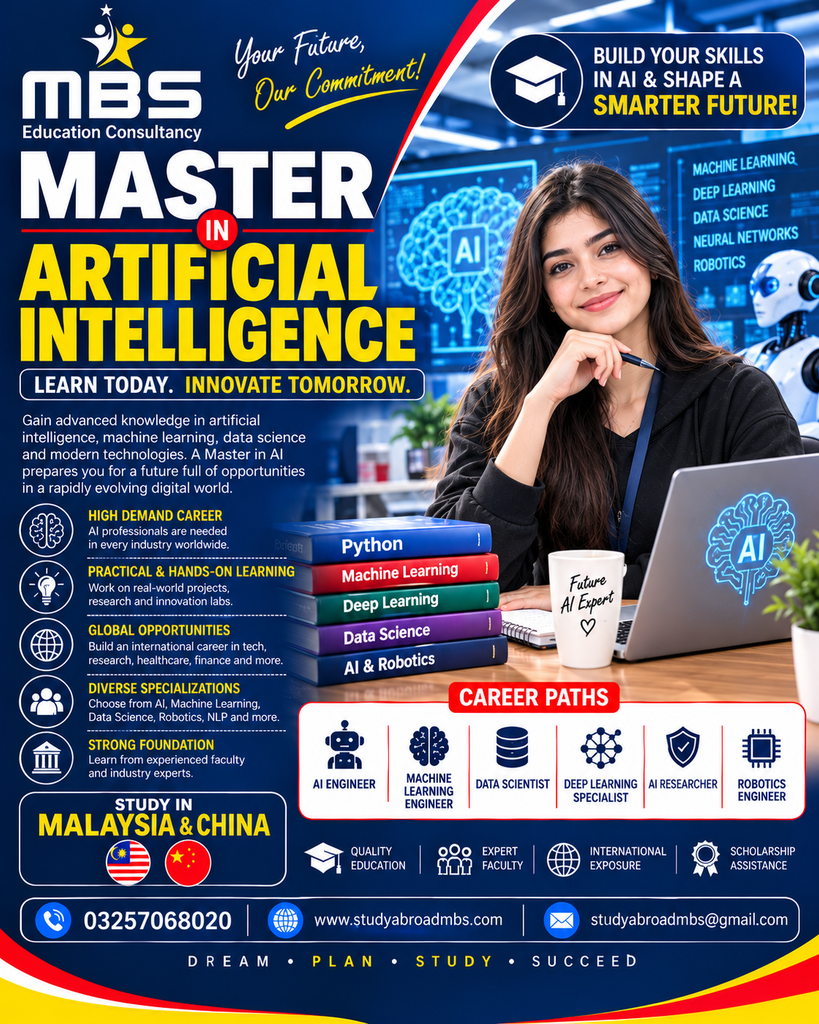
What Is a Master in Artificial Intelligence?
A Master in Artificial Intelligence focuses on the theories, technologies and practical methods used to build intelligent computer systems.
Students learn how computers can process information, identify patterns, make predictions, understand language and solve complex problems.
The program may cover areas such as:
- Artificial Intelligence
- Machine Learning
- Deep Learning
- Data Science
- Neural Networks
- Natural Language Processing
- Computer Vision
- Robotics
- Big Data Analytics
- Intelligent Systems
- Cloud Computing
- AI Ethics
- Research Methods
The exact subjects depend on the university and whether the program is coursework, mixed mode or research-based.
Quick Overview
| Category | Details |
| Program | Master in Artificial Intelligence |
| Study Level | Postgraduate / Master’s Degree |
| Destination | Malaysia |
| Intake | 2026–2027 |
| Typical Duration | 1–2 Years |
| Study Mode | Full-Time / Part-Time |
| Medium of Instruction | English |
| Estimated Tuition Fee | RM 25,000 – RM 55,000+ |
| Academic Background | Computing, IT, Computer Science, Engineering or Related Field |
| International Students | Yes |
| Main Career Areas | AI, Machine Learning, Data Science, Software, Research |
Why Study Artificial Intelligence in Malaysia?
Growing Demand for AI Professionals
Artificial Intelligence is becoming increasingly important across different industries. Businesses are using AI for automation, data analysis, customer services, security and decision-making.
Modern Technology Environment
Students can develop knowledge in modern technologies such as machine learning, deep learning, cloud computing, computer vision and intelligent systems.
Affordable International Education
Malaysia can offer comparatively affordable tuition and living expenses compared with several other popular international study destinations.
English-Taught Education
Many postgraduate programs for international students are taught in English, making Malaysia accessible to Pakistani students.
Multicultural Study Environment
Malaysia has an international student community and provides students with exposure to different cultures and academic environments.
What Will You Study?
The exact curriculum varies, but common subjects may include:
| Study Area | Possible Subjects |
| Artificial Intelligence | Advanced Artificial Intelligence |
| Machine Learning | Machine Learning Techniques |
| Deep Learning | Deep Neural Networks and Deep Learning |
| Data | Data Analytics and Data Mining |
| Programming | Advanced Programming |
| Computer Vision | Image Processing and Computer Vision |
| Language | Natural Language Processing |
| Robotics | Intelligent Robotics |
| Big Data | Big Data Technologies |
| Research | Research Methodology |
| Ethics | AI Ethics and Responsible AI |
| Applications | Applied Artificial Intelligence |
Popular Areas of Specialization
Students may be able to focus on different AI-related areas, including:
- Machine Learning
- Deep Learning
- Generative AI
- Natural Language Processing
- Computer Vision
- Robotics
- Data Science
- Predictive Analytics
- Intelligent Systems
- Autonomous Systems
- AI for Healthcare
- AI for Business
- AI and Cybersecurity
- Big Data and Analytics
The availability of specific specializations depends on the selected university.
Duration of the Program
The duration depends on the university, academic background and program structure.
| Program Type | Typical Duration |
| Full-Time Coursework | Around 1–2 Years |
| Mixed Mode | Around 1.5–2 Years |
| Research-Based | Around 2 Years or More |
| Part-Time | Usually Longer |
Students should check the exact duration of their chosen program before applying.
Intakes in Malaysia
Intake dates vary between institutions and programs.
Common intake periods may include:
- January
- February/March
- May/June
- September/October
Students interested in the 2026–2027 intake should plan their application according to the available intake of their selected program.
Estimated Tuition Fees
Tuition fees depend on the university, program structure and duration.
| Expense | Estimated Cost |
| Master’s Tuition Fee | RM 25,000 – RM 55,000+ |
| Application/Registration Charges | Varies |
| Student Visa/Related Charges | Varies |
| Insurance | Varies |
| Laboratory/Technology Expenses | Varies |
These figures are general estimates for planning purposes. Actual fees can vary significantly between institutions.
Cost of Living in Malaysia
The cost of living depends on the city, accommodation and personal lifestyle.
| Expense | Estimated Monthly Cost |
| Accommodation | RM 500 – RM 1,200 |
| Food | RM 500 – RM 900 |
| Transportation | RM 100 – RM 300 |
| Mobile/Internet | RM 50 – RM 150 |
| Personal Expenses | RM 200 – RM 400 |
| Approximate Total | RM 1,350 – RM 2,950 |
Students living in major cities or choosing private accommodation may have higher monthly expenses.
Estimated Total Study Budget
Students should plan for tuition fees as well as accommodation, food, transportation, visa-related expenses and personal costs.
| Budget Category | Estimated Range |
| Tuition Fee | RM 25,000 – RM 55,000+ |
| Living Expenses | RM 16,000 – RM 30,000+ per year |
| Visa, Insurance & Other Costs | Varies |
| Study/Technology Expenses | Varies |
| Overall Budget | Depends on University and Lifestyle |
Admission Requirements
Typical admission requirements may include:
- A recognized bachelor’s degree
- Relevant academic background
- Academic transcripts
- Degree certificate
- English language proficiency
- Valid passport
- Updated CV
- Personal statement or study plan, if required
- Recommendation letters, if required
- Work experience, where applicable
Some programs may also require applicants to have previous knowledge of programming, mathematics, statistics or computing.
Eligibility for Pakistani Students
Pakistani students with a relevant bachelor’s degree can apply if they meet the admission requirements of the selected institution.
Common academic backgrounds include:
- Bachelor of Artificial Intelligence
- Bachelor of Computer Science
- Bachelor of Software Engineering
- Bachelor of Information Technology
- Bachelor of Data Science
- Bachelor of Computer Engineering
- Electrical/Electronic Engineering
- Other relevant computing or engineering degrees
Students from related fields may also be considered depending on the university’s requirements.
English Language Requirements
Most international students may need to demonstrate English language proficiency.
| Test | Typical Requirement |
| IELTS | Around 6.0, depending on university |
| TOEFL | University dependent |
| Other Accepted Tests | Depending on institution |
| Alternative English Evidence | May be accepted in some cases |
Exact requirements vary, so students should check the requirements of their chosen program before applying.
Mathematical and Programming Background
Artificial Intelligence involves mathematics, statistics and programming.
Students may benefit from having previous knowledge of:
- Python or another programming language
- Mathematics
- Statistics
- Algorithms
- Data Structures
- Databases
- Basic Machine Learning
The required level of previous knowledge depends on the university and program.
Documents Required
Pakistani students should normally prepare:
- Valid Passport
- Bachelor’s Degree Certificate
- Academic Transcripts
- Passport-size Photograph
- Updated CV
- English Language Certificate, if required
- Personal Statement or Study Plan, if required
- Recommendation Letters, if required
- Work Experience Documents, if applicable
- Other documents requested by the university
Students should make sure all academic documents are clear and properly prepared before submitting an application.
Application Process
Step 1 – Select an AI Program
Choose a master’s program according to your academic background and career goals.
Step 2 – Check Eligibility
Review the academic, English-language, programming and other admission requirements.
Step 3 – Prepare Documents
Prepare your degree, transcripts, passport, CV and other required documents.
Step 4 – Submit the Application
Complete the application and submit the required documents.
Step 5 – Receive the Offer Letter
If accepted, the university may issue an offer or admission letter.
Step 6 – Accept the Offer
Follow the university’s instructions for accepting the offer and completing any required formalities.
Step 7 – Student Visa Process
Begin the required Malaysian student pass and visa procedures for international students.
Step 8 – Travel to Malaysia
After receiving the required approval, arrange your travel and accommodation.
Step 9 – University Registration
Complete registration and orientation after arriving in Malaysia.
Student Visa Process for Pakistani Students
International students need the appropriate Malaysian student pass and visa arrangements before starting their studies.
The general process includes:
- Receiving university admission
- Student pass application
- Submission of required documents
- Immigration procedures
- Medical and insurance requirements, where applicable
- Visa approval
- Travel arrangements
- University registration after arrival
Visa rules and procedures can change, so students should follow the latest requirements applicable to their admission.
Scholarships and Financial Support
International students may find different scholarship and financial-support opportunities.
Possible options include:
- University scholarships
- Merit-based scholarships
- Tuition fee reductions
- Research funding
- Postgraduate financial assistance
- Government or institutional scholarship schemes
Scholarship availability and eligibility vary, so students should research funding options early.
Research-Based Master in Artificial Intelligence
Students interested in research and future PhD studies can consider a research-based Master’s in Artificial Intelligence where available.
Possible research areas include:
- Machine Learning
- Deep Learning
- Generative AI
- Natural Language Processing
- Computer Vision
- Robotics
- AI Ethics
- Explainable AI
- Healthcare AI
- Autonomous Systems
- Reinforcement Learning
- Data Mining
- Intelligent Systems
- Human-Computer Interaction
Research students may need to prepare a research proposal and work under the supervision of an academic researcher.
Career Opportunities After Master in Artificial Intelligence
Artificial Intelligence graduates can pursue careers across technology and other industries.
Potential career roles include:
- AI Engineer
- Machine Learning Engineer
- AI Developer
- Data Scientist
- Data Analyst
- Machine Learning Researcher
- Computer Vision Engineer
- NLP Engineer
- Robotics Engineer
- AI Consultant
- Software Engineer
- Data Engineer
- Research Scientist
- Business Intelligence Specialist
- AI Product Manager
- Technology Consultant
Job titles and requirements depend on the employer, industry and professional experience.
Industries You Can Work In
AI professionals can work in many industries, including:
- Information Technology
- Software Development
- Banking and FinTech
- Healthcare
- E-Commerce
- Telecommunications
- Manufacturing
- Automotive
- Education
- Cybersecurity
- Retail
- Logistics
- Robotics
- Digital Marketing
- Government Technology
- Research and Development
- Technology Startups
Skills You Can Develop
Technical Skills
- Python programming
- Machine learning
- Deep learning
- Data analysis
- Neural networks
- Computer vision
- Natural language processing
- Data mining
- AI model development
- Cloud computing
- Algorithm development
- Statistical analysis
Professional Skills
- Problem solving
- Critical thinking
- Research
- Communication
- Teamwork
- Project management
- Technical documentation
- Analytical thinking
Is Master in Artificial Intelligence Suitable for Pakistani Students?
Yes. It can be a strong option for Pakistani students who have a background in computing, information technology, software engineering, data science or related fields.
The degree can be particularly useful for students who want to:
- Build advanced AI skills
- Become machine learning professionals
- Enter data science
- Work with generative AI
- Develop intelligent applications
- Work in research and development
- Move into advanced technology roles
- Prepare for PhD studies
Who Should Study This Degree?
A Master in Artificial Intelligence may be suitable for:
- Computer Science graduates
- Artificial Intelligence graduates
- Software Engineering graduates
- Information Technology graduates
- Data Science graduates
- Computer Engineering graduates
- Engineering graduates with relevant computing knowledge
- Software developers
- Data professionals
- IT professionals
- Students interested in advanced AI technologies
Important Things to Check Before Applying
Before selecting a university, students should carefully check:
- University recognition
- Program curriculum
- AI specialisations
- Tuition fees
- Program duration
- Available intake
- Admission requirements
- English requirements
- Programming prerequisites
- Mathematics requirements
- Coursework or research options
- Laboratory and computing facilities
- Industry exposure
- Scholarship opportunities
- Accommodation options
- Total study budget
- Student visa requirements
Frequently Asked Questions
Is Master in Artificial Intelligence available in Malaysia?
Yes. Malaysian institutions offer postgraduate programs in Artificial Intelligence, Computer Science, Data Science and related technology fields.
How long does a Master’s in Artificial Intelligence take?
A full-time program commonly takes around 1 to 2 years, depending on the university and program structure.
What is the estimated tuition fee?
International students should generally plan for approximately RM 25,000 to RM 55,000 or more, although actual fees vary between institutions.
Can Pakistani students apply for a Master’s in AI in Malaysia?
Yes. Pakistani students can apply if they meet the academic, English-language and other requirements of the selected institution.
Do I need a bachelor’s degree in Artificial Intelligence?
Not necessarily. Students with degrees in Computer Science, Software Engineering, Information Technology, Data Science, Computer Engineering and related fields may also be eligible.
Is IELTS required?
It may be required for international students. Some institutions may accept alternative evidence of English proficiency.
Do I need programming knowledge?
Programming knowledge is highly useful for AI studies. Python is particularly important in many AI and machine learning applications.
Is mathematics required for Artificial Intelligence?
Yes. Mathematics and statistics are important parts of AI and machine learning. The exact prerequisite level depends on the program.
Can I work as a Data Scientist after this degree?
Yes. A Master’s in Artificial Intelligence can provide relevant skills for data science roles, particularly when the program includes statistics, data analysis and machine learning.
Can I continue to a PhD after a Master’s in AI?
Yes. Graduates can potentially continue to PhD-level study in Artificial Intelligence, Computer Science, Machine Learning, Data Science or related fields, subject to admission requirements.
Can I work while studying in Malaysia?
International student work permissions are subject to Malaysian immigration rules and the conditions applicable to international students. Students should check the current rules before making employment plans.
Final Checklist for Pakistani Students
Before applying for the 2026–2027 intake, make sure you have:
☑ Valid passport
☑ Bachelor’s degree
☑ Academic transcripts
☑ English language evidence
☑ Updated CV
☑ Personal statement/study plan, if required
☑ Recommendation letters, if required
☑ Relevant programming or technical background
☑ Financial plan
☑ Admission documents
☑ Student visa/pass documents
Final Thoughts
A Master in Artificial Intelligence in Malaysia can be an excellent choice for students who want to develop advanced skills in artificial intelligence, machine learning, data analysis and intelligent technologies.
The degree can open career opportunities in AI engineering, machine learning, data science, software development, research, robotics and many other technology-related fields.
For Pakistani students, Malaysia offers an international education environment with comparatively manageable tuition and living costs.
Before applying for the 2026–2027 intake, students should compare the curriculum, AI specializations, tuition fees, entry requirements, duration, research opportunities and overall study budget of different programs.
The best AI master’s program is one that matches your academic background, technical interests and long-term career goals.