
Guide for Pakistani Students
A PhD in Data Science is an advanced research degree for students who want to become experts in data analysis, machine learning, artificial intelligence, big data and advanced computing.
Data Science combines statistics, mathematics, programming, artificial intelligence and machine learning to find useful information from large and complex datasets.
Malaysia offers research-based PhD opportunities in Data Science and closely related areas such as Artificial Intelligence, Machine Learning, Big Data, Data Analytics, Data Visualisation and Computer Science.
For Pakistani students with a relevant Master’s degree, Malaysia can be an option for advanced study and research in this rapidly growing field.
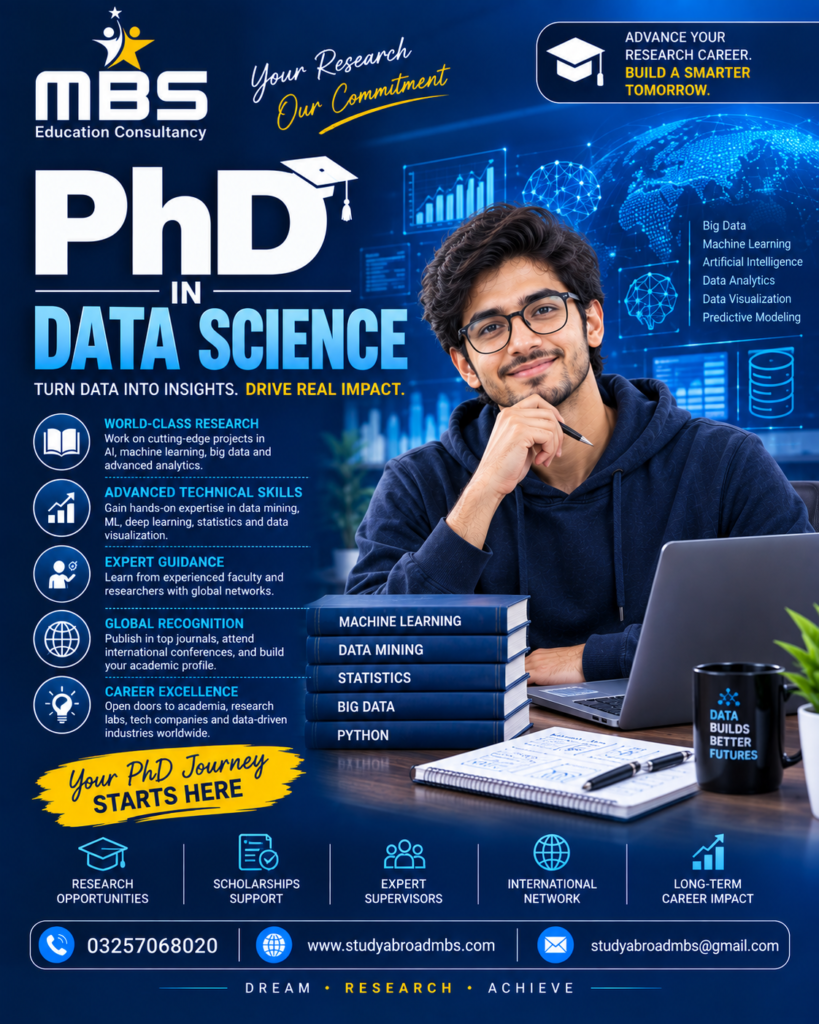
What is a PhD in Data Science?
A PhD in Data Science is primarily a research-based doctoral programme.
Students normally choose a specific research problem, develop a research proposal, work with a supervisor, conduct original research, analyse data and write a doctoral thesis.
The research can involve:
- Big Data
- Machine Learning
- Artificial Intelligence
- Statistical Modelling
- Data Mining
- Predictive Analytics
- Deep Learning
- Data Visualisation
- Natural Language Processing
- Computer Vision
- Business Analytics
- Healthcare Analytics
- Financial Data Science
- Social Data Analysis
The aim is to develop new knowledge, methods, models or applications that contribute to the field of Data Science.
Why Study PhD in Data Science in Malaysia?
Malaysia has developed postgraduate research opportunities in computing, information technology and data-related fields.
For example, INTI offers a specific PhD in Data Science by research, while UOW Malaysia includes Data Science among its Computing and Innovation research areas. Universiti Malaya also offers research-based PhD study within its Faculty of Computer Science and Information Technology.
For Pakistani students, studying Data Science in Malaysia can provide:
- International academic exposure
- Research-based doctoral education
- Access to modern computing and research facilities
- Opportunity to work with experienced researchers
- Advanced data analysis skills
- Exposure to international research
- Opportunities for interdisciplinary research
- A multicultural study environment
Popular Research Areas in Data Science
Data Science is a very broad field.
Depending on the university and supervisor, students can research areas such as:
- Machine Learning
- Deep Learning
- Artificial Intelligence
- Big Data Analytics
- Data Mining
- Predictive Analytics
- Statistical Data Science
- Data Visualisation
- Natural Language Processing
- Computer Vision
- Generative AI
- Large Language Models
- Business Analytics
- Financial Data Science
- Healthcare Data Science
- Bioinformatics
- Social Media Analytics
- Educational Data Analytics
- Customer Analytics
- Fraud Detection
- Risk Analytics
- Recommendation Systems
- Time Series Analysis
- Cloud Computing
- Distributed Computing
- Internet of Things
- Data Engineering
- Data Privacy
- Data Security
- Knowledge Discovery
- Decision Support Systems
Machine Learning
Machine Learning is one of the most important areas of modern Data Science.
Research may focus on developing algorithms that allow computers to learn patterns from data.
Possible research areas include:
- Supervised learning
- Unsupervised learning
- Reinforcement learning
- Predictive modelling
- Classification
- Regression
- Clustering
- Feature selection
- Automated machine learning
- Explainable AI
Deep Learning
Deep Learning uses advanced neural networks to analyse complex datasets.
Research can include:
- Neural networks
- Convolutional neural networks
- Recurrent neural networks
- Transformer models
- Deep reinforcement learning
- Image recognition
- Speech recognition
- Natural language processing
Deep Learning can be applied to healthcare, finance, education, cybersecurity, business and many other fields.
Artificial Intelligence and Data Science
AI and Data Science are closely connected.
A PhD student may research how data can be used to develop intelligent systems.
Possible topics include:
- Intelligent decision-making
- Predictive AI
- Generative AI
- AI-based recommendation systems
- Intelligent automation
- Explainable AI
- AI for healthcare
- AI for business
- AI for education
- AI for cybersecurity
Big Data Analytics
Modern organisations generate enormous amounts of data.
Big Data research focuses on methods for storing, processing and analysing these large datasets.
Research may involve:
- Big data platforms
- Distributed computing
- Cloud data processing
- Real-time analytics
- Large-scale data mining
- Data integration
- Streaming data
- Big data visualisation
Data Mining
Data Mining involves discovering useful patterns and relationships within large datasets.
Research can focus on:
- Pattern recognition
- Classification
- Clustering
- Association rules
- Anomaly detection
- Knowledge discovery
- Predictive modelling
Data Visualisation
Data visualisation helps researchers and organisations understand complex information.
Research may include:
- Interactive visualisation
- Visual analytics
- Scientific visualisation
- Business dashboards
- Geographic data visualisation
- High-dimensional data visualisation
- Human-computer interaction
UOW Malaysia currently lists Data Visualisation among its PhD research areas within Computing and Innovation.
Natural Language Processing
Natural Language Processing, or NLP, focuses on using computers to understand and process human language.
Possible research topics include:
- Text classification
- Sentiment analysis
- Machine translation
- Speech recognition
- Chatbots
- Text summarisation
- Question answering
- Large language models
- Information extraction
Computer Vision
Computer Vision allows computers to analyse and understand images and videos.
Research may include:
- Image classification
- Object detection
- Facial recognition
- Medical imaging
- Video analysis
- Pattern recognition
- Image segmentation
- Automated visual inspection
Healthcare Data Science
Data Science can be applied to healthcare and medical research.
Possible research topics include:
- Disease prediction
- Medical data analysis
- Patient risk prediction
- Medical imaging
- Healthcare forecasting
- Clinical decision support
- Health data management
- Personalised medicine
Financial Data Science
Students interested in finance can combine Data Science with financial research.
Possible topics include:
- Stock market prediction
- Risk analysis
- Fraud detection
- Credit scoring
- Financial forecasting
- Algorithmic trading
- Customer analytics
- Financial anomaly detection
Business Data Science
Businesses use data to understand customers, markets and operations.
Research can include:
- Customer behaviour
- Marketing analytics
- Sales forecasting
- Business intelligence
- Customer segmentation
- Supply chain analytics
- Decision support systems
- Predictive business models
Cybersecurity and Data Science
Data Science can also be used to identify cybersecurity threats.
Research may include:
- Anomaly detection
- Intrusion detection
- Malware analysis
- Fraud detection
- Network traffic analysis
- Security analytics
- Threat prediction
Duration of PhD in Data Science in Malaysia
The duration depends on the university and study mode.
INTI currently lists its PhD in Data Science as:
Full-time: 3 years
Part-time: 4 years.
The University of Malaya’s research-based PhD in the Faculty of Computer Science and Information Technology lists a 6-semester full-time duration.
UOW Malaysia’s Computing and Innovation PhD also offers a research route covering Data Science, with the programme completed through research, thesis and viva voce.
Students should normally plan for approximately 3 to 4 years full-time, although the actual completion time can vary.
Study Structure
A research-based PhD in Data Science normally includes:
- Selecting a research area
- Finding a suitable supervisor
- Developing a research proposal
- Completing research methodology requirements
- Proposal defence
- Conducting original research
- Collecting and analysing data
- Publishing research where required
- Writing the doctoral thesis
- Thesis examination
- Viva voce
- Final submission
INTI’s current PhD in Data Science structure includes Research Methodology, Proposal Defence, Research Thesis Supervision, a minimum 40,000-word thesis and Viva Voce.
Intakes for 2026–2027
Intakes depend on the university.
INTI currently lists January, May and September intakes for its PhD in Data Science.
UOW Malaysia currently lists 2026 intake dates of:
- 23 January 2026
- 2 June 2026
- 11 September 2026
for its PhD in Computing and Innovation, which includes Data Science as a research area.
Universiti Malaya’s Faculty of Computer Science and Information Technology states that applications and admission for its research PhD are open throughout the year.
For 2026–2027 applications, students should confirm the latest intake with the university before submitting documents.
Eligibility for Pakistani Students
The admission requirements depend on the university.
Generally, applicants should have a relevant Master’s degree.
For example, INTI accepts:
- A Master’s degree in Computing or a related field
- A Master’s degree in a non-Computing field with relevant Computing work experience, subject to university requirements
- Other equivalent qualifications recognised by the relevant Malaysian authorities.
UOW Malaysia requires a Master’s degree in Computing or a related field for its Computing and Innovation PhD, while applicants from a non-Computing background may be considered with relevant work experience and prerequisite courses.
Which Master’s Degrees Can Be Relevant?
Depending on the university and research topic, relevant backgrounds may include:
- Data Science
- Computer Science
- Information Technology
- Artificial Intelligence
- Software Engineering
- Information Systems
- Statistics
- Mathematics
- Computer Engineering
- Data Analytics
- Business Analytics
- Engineering
- Bioinformatics
- Economics
- Finance
- Other closely related fields
The final decision depends on the university, proposed research and supervisor.
Can a Non-Computing Student Apply?
Yes, some universities may consider students from non-Computing backgrounds.
For example, INTI states that applicants with a non-Computing Master’s may be considered if they have relevant Computing work experience, with additional prerequisite or assessment requirements depending on their background.
UOW Malaysia also allows consideration of non-Computing Master’s graduates with relevant Computing experience, subject to prerequisite requirements.
Therefore, students from fields such as Finance, Business, Engineering or Economics may have options at some universities if they can demonstrate relevant data or computing experience.
English Language Requirements
International students normally need to demonstrate English proficiency.
Requirements vary between universities.
For example, INTI currently lists IELTS 6.0 or accepted equivalent evidence for its PhD in Data Science. It may also accept a Master’s degree conducted in English, subject to the university’s documentation requirements.
UOW Malaysia lists IELTS 6.0 for international students applying to its Computing and Innovation PhD.
Students should check the exact English requirement before applying.
Research Proposal
A research proposal is one of the most important parts of a Data Science PhD application.
A good proposal should normally include:
- Research title
- Background
- Research problem
- Research gap
- Research objectives
- Research questions
- Literature review
- Proposed methodology
- Dataset or data source
- Machine learning or statistical methods
- Evaluation method
- Expected results
- Research contribution
- References
For a Data Science proposal, students should clearly explain what problem they want to solve and how their proposed method can provide a meaningful research contribution.
Finding a PhD Supervisor
Choosing a suitable supervisor is very important.
Students should look for supervisors whose research matches their intended topic.
For example:
Machine Learning: Find researchers working on machine learning, predictive modelling or deep learning.
Healthcare Data Science: Look for researchers working on medical data, health analytics or AI in healthcare.
Financial Data Science: Look for supervisors working on financial analytics, econometrics or computational finance.
NLP: Look for researchers working on language models, NLP or text analytics.
Computer Vision: Look for researchers working on image processing, computer vision or pattern recognition.
A strong match between your research proposal and the supervisor’s expertise can make the application process more suitable.
Documents Required
Pakistani students may normally need:
- Valid passport
- Passport-size photograph
- Bachelor’s degree certificate
- Master’s degree certificate
- Bachelor’s transcripts
- Master’s transcripts
- Updated CV
- Research proposal
- English language certificate
- Statement of purpose, if required
- Recommendation letters, if required
- Research publications, if available
- Work experience documents, if applicable
- Other documents requested by the university
Some documents may need certification or attestation.
Admission Process for Pakistani Students
Step 1 – Select Your Research Area
Choose an area such as Machine Learning, AI, Big Data, Data Analytics, NLP or another Data Science field.
Step 2 – Find Suitable Universities
Search for Malaysian universities offering Data Science or closely related PhD research programmes.
Step 3 – Check Eligibility
Check your Master’s degree, academic background, CGPA and English-language requirement.
Step 4 – Find a Supervisor
Identify a supervisor whose research interests match your proposed topic.
Step 5 – Prepare Your Research Proposal
Develop a clear research proposal explaining the problem, research gap and proposed methodology.
Step 6 – Prepare Documents
Collect your academic documents, passport, CV, proposal and English certificate.
Step 7 – Submit Application
Submit your application through the university’s postgraduate admission process.
Step 8 – University Assessment
The university may assess your academic qualifications, research proposal and supervisor availability.
Step 9 – Receive Offer Letter
If accepted, complete the required acceptance procedures.
Step 10 – Student Visa Process
After admission, complete the required Malaysian student pass process.
Step 11 – Start Your PhD
After completing the required formalities, begin your research programme.
Student Visa for Pakistani Students
Pakistani students who receive admission to a Malaysian university must complete the required student pass process for international students.
The exact visa procedure and documents can change according to current Malaysian immigration requirements.
Students should keep their passport, admission documents, financial documents and other required paperwork ready.
PhD in Data Science Fees in Malaysia
Fees vary between universities.
INTI currently lists an approximate total fee of RM59,796 for its PhD in Data Science. The university states that the published fee is exclusive of 6% SST for international students.
For comparison, Universiti Malaya currently lists RM86,600 for its international research PhD under the Faculty of Computer Science and Information Technology, excluding 6% SST.
UOW Malaysia currently estimates RM68,300 for international students for the minimum period of its Computing and Innovation PhD.
Fees can change, so students should confirm the latest fee before making financial plans.
Living Expenses in Malaysia
Apart from tuition, Pakistani students should budget for:
- Accommodation
- Food
- Local transportation
- Mobile and internet
- Study materials
- Health insurance
- Visa-related expenses
- Personal expenses
- Air tickets
Living costs depend on the city and lifestyle.
Students living in Kuala Lumpur may have different expenses from students living in other Malaysian cities.
Scholarships and Funding
Scholarships and research funding may be available depending on the university, faculty and research project.
Possible funding sources include:
- University scholarships
- Research grants
- Graduate research assistantships
- Faculty funding
- Supervisor-supported research projects
- External scholarships
Some universities may have separate scholarship application deadlines.
Students should check the scholarship conditions carefully because funding is competitive and is not automatically included with admission.
Career Opportunities After PhD in Data Science
A PhD in Data Science can prepare graduates for advanced careers in research, academia, technology and data-driven industries.
Possible career paths include:
- Data Scientist
- Senior Data Scientist
- Research Scientist
- Machine Learning Scientist
- AI Researcher
- Data Analyst
- Data Engineer
- Machine Learning Engineer
- Data Architect
- Data Science Consultant
- Business Intelligence Specialist
- Quantitative Analyst
- Data Researcher
- University Lecturer
- University Professor
- Research Officer
- AI Specialist
- Big Data Specialist
- Data Analytics Consultant
Universities and technology companies may also employ Data Science PhD graduates in research and development roles. INTI lists careers such as Data Scientist, Machine Learning Scientist, Data Engineer, Data Architect and Business Research Consultant among potential career paths.
Is PhD in Data Science Difficult?
A PhD in Data Science can be academically demanding because it requires original research.
Students may need to work with:
- Programming
- Statistics
- Mathematics
- Machine Learning
- Large datasets
- Research papers
- Data analysis
- Academic writing
- Experimental evaluation
The difficulty depends on the research topic, technical background, dataset, methodology and supervisor support.
Students with a strong interest in programming, statistics, AI and problem-solving may find the field suitable.
Who Should Study PhD in Data Science?
This programme may be suitable for students who:
- Have a relevant Master’s degree
- Enjoy working with data
- Are interested in programming
- Like statistics and mathematics
- Are interested in Artificial Intelligence
- Want to conduct machine learning research
- Want an academic or research career
- Want to work in advanced technology
- Enjoy solving complex problems
- Are prepared for several years of independent research
Advantages for Pakistani Students
A Malaysian PhD in Data Science can provide:
- International research exposure
- Advanced technical skills
- Experience with modern data technologies
- Research experience in AI and machine learning
- Opportunities for interdisciplinary research
- Academic and industry research opportunities
- Preparation for specialised technology careers
Estimated Budget
The total budget depends on the university, city, duration and lifestyle.
The main expenses include:
1. Tuition Fee
Depends on the selected university.
2. Accommodation
Depends on location and type of accommodation.
3. Food and Daily Expenses
Depends on personal lifestyle.
4. Visa and Insurance
Required costs for international students.
5. Research Expenses
Some research projects may require computing resources, software, datasets, cloud services or other research-related costs.
6. Travel and Personal Expenses
Flights, transportation and personal expenses should also be included.
A final budget should be prepared after selecting the university and programme.
Important Things to Check Before Applying
Before applying for a PhD in Data Science in Malaysia, Pakistani students should check:
- Is the programme specifically Data Science or a related Computing PhD?
- Is it research-based?
- Is your Master’s degree relevant?
- Does your CGPA meet the requirement?
- Is your research topic available?
- Is a suitable supervisor available?
- What English test is accepted?
- What is the latest international tuition fee?
- What additional fees apply?
- What are the intake dates?
- Are international students accepted for the selected study mode?
- What documents require attestation?
- What are the current student visa requirements?
- Is scholarship or research funding available?
Frequently Asked Questions
Can Pakistani students study PhD in Data Science in Malaysia?
Yes. Pakistani students can apply to eligible Malaysian Data Science and related Computing PhD programmes if they meet the university’s admission requirements.
Do I need a Master’s degree?
Normally, yes. A relevant Master’s degree is the standard route. Some universities may consider applicants from non-Computing backgrounds if they have relevant professional experience and meet additional requirements.
Can a Computer Science graduate apply?
Yes. Computer Science is one of the most directly relevant backgrounds for a PhD in Data Science.
Can an IT graduate apply?
Yes. Information Technology can be relevant, depending on the university and proposed research area.
Can a Statistics or Mathematics graduate apply?
Yes. Statistics and Mathematics can be highly relevant backgrounds, particularly for research involving statistical modelling, machine learning and quantitative data analysis.
Can a Finance graduate apply?
Possibly. Some universities may consider non-Computing backgrounds where the applicant has relevant Computing or data-related experience and meets additional requirements.
What IELTS score is required?
It depends on the university. INTI and UOW Malaysia currently list IELTS 6.0 for their relevant international PhD applicants.
How long does a PhD in Data Science take?
A full-time PhD can generally take around 3 to 4 years, depending on the university and research progress.
Is PhD Data Science research-based?
Yes. INTI specifically offers its Data Science PhD by research, while other universities offer Data Science as a research area within Computing PhD programmes.
Can I specialise in Artificial Intelligence?
Yes. AI, Machine Learning and Deep Learning are closely connected with Data Science and are common research areas.
Can I research Big Data?
Yes. Big Data Analytics, distributed computing and large-scale data processing can be studied as part of Data Science or Computing research.
Is a research proposal required?
For research-based PhD applications, a research proposal is commonly an important part of the application. INTI’s programme specifically includes Proposal Defence as part of its research structure.
Can I work after completing the PhD?
A PhD in Data Science can prepare graduates for research, academic, technology and data-related careers. Employment and work rights depend on the immigration and employment rules of the country where you seek work.
Final Conclusion
A PhD in Data Science in Malaysia 2026–2027 can be an option for Pakistani students who want to build advanced expertise in data analytics, artificial intelligence, machine learning and big data.
The field offers a wide range of research opportunities, including Machine Learning, Deep Learning, Big Data, Data Mining, NLP, Computer Vision, Healthcare Data Science, Financial Data Science and Business Analytics.
Because the PhD is primarily research-based, selecting the right research topic and supervisor is one of the most important parts of the admission process.
Pakistani students should carefully check their academic eligibility, English requirement, supervisor availability, tuition fees, intake dates and student visa requirements before applying.
With the right academic background and research interest, a PhD in Data Science can prepare students for advanced careers in research, academia, technology and data-driven industries.