
Guide for Pakistani Students
A PhD in Environmental Science is an advanced research degree for students who want to study environmental problems and develop scientific solutions for protecting natural resources, ecosystems and human health.
Environmental Science is a multidisciplinary field that combines areas such as biology, chemistry, geography, ecology, environmental management, climate science, water resources and pollution control.
Malaysia offers research-based PhD opportunities in Environmental Science and related areas. For example, Universiti Sultan Zainal Abidin (UniSZA) offers a research-based PhD specifically in Environmental Science, while UKM offers Environmental Sciences within its Science and Technology PhD and research opportunities in Environment and Development.
For Pakistani students with a relevant academic background, Malaysia can be an option for pursuing advanced environmental research in an international academic environment.
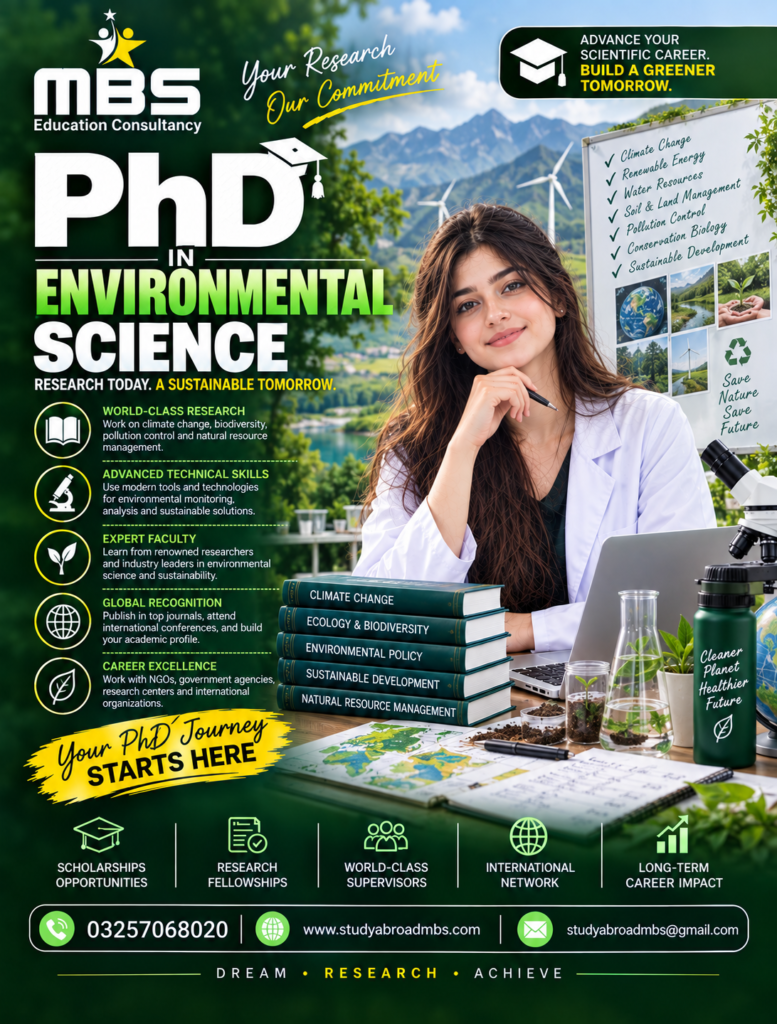
What is a PhD in Environmental Science?
A PhD in Environmental Science is mainly a research-based doctoral programme.
Students normally choose a specific environmental problem, develop a research proposal, work with a supervisor, conduct original research, analyse data and write a doctoral thesis.
The research can involve laboratory work, field studies, environmental sampling, surveys, statistical analysis, satellite data, computer modelling or other scientific research methods.
The main purpose is to produce new knowledge that can contribute to environmental protection, sustainability, resource management or environmental policy.
Why Study PhD in Environmental Science in Malaysia?
Malaysia has a diverse natural environment, including tropical forests, rivers, wetlands, coastal areas, marine ecosystems and rapidly developing urban areas.
This creates opportunities for research in different environmental fields.
For Pakistani students, studying Environmental Science in Malaysia can provide:
- International research exposure
- Research-based doctoral education
- Access to university research facilities
- Opportunity to work with experienced supervisors
- Exposure to tropical and regional environmental issues
- Development of advanced research skills
- Opportunities for interdisciplinary research
- A multicultural academic environment
Popular Research Areas in Environmental Science
Environmental Science covers many different research areas.
Depending on the university and available supervisor, students may specialise in:
- Environmental Pollution
- Water Quality
- Air Pollution
- Soil Pollution
- Waste Management
- Environmental Chemistry
- Environmental Biology
- Ecology
- Biodiversity
- Conservation Biology
- Climate Change
- Global Warming
- Environmental Management
- Environmental Monitoring
- Environmental Impact Assessment
- Natural Resource Management
- Forest Management
- Marine Environment
- Coastal Management
- Wetland Management
- Sustainable Development
- Renewable Energy
- Environmental Biotechnology
- Environmental Microbiology
- Environmental Toxicology
- Environmental Health
- Geographic Information Systems
- Remote Sensing
- Geospatial Science
- Disaster Management
- Sustainable Cities
- Environmental Policy
- Environmental Governance
- Water Resources Management
- Wastewater Treatment
- Sustainable Agriculture
- Food and Environmental Security
UKM’s Science and Technology PhD currently includes Environmental Sciences as a research area, while its Environment and Development PhD includes areas such as ecosystem and landscape, environmental governance, natural resources, environmental health, waste, biological heritage and disaster management.
Environmental Pollution
Environmental pollution is one of the major areas of Environmental Science research.
Students can investigate:
- Air pollution
- Water pollution
- Soil contamination
- Industrial pollution
- Plastic pollution
- Chemical pollutants
- Heavy metals
- Agricultural pollution
- Urban pollution
Research may focus on identifying pollution sources, measuring environmental impacts and developing methods for pollution control.
Water Quality and Water Resources
Water-related research is an important part of Environmental Science.
Possible research topics include:
- Drinking water quality
- River pollution
- Groundwater quality
- Wastewater treatment
- Industrial wastewater
- Water resource management
- Water pollution monitoring
- Microbial contamination
- Water quality modelling
Research can combine laboratory testing, field sampling and data analysis.
Climate Change and Global Warming
Climate change is another major research area.
Possible topics include:
- Climate change impacts
- Carbon emissions
- Greenhouse gases
- Climate adaptation
- Climate mitigation
- Extreme weather
- Flood risk
- Drought
- Climate-resilient communities
- Carbon management
- Sustainable development
Students can study how climate change affects ecosystems, cities, agriculture, water resources and communities.
Ecology and Biodiversity
This area focuses on ecosystems, plants, animals and their relationship with the environment.
Research may include:
- Biodiversity conservation
- Ecosystem health
- Wildlife habitats
- Forest ecosystems
- Marine ecosystems
- Wetlands
- Species conservation
- Ecological restoration
- Invasive species
- Human impact on ecosystems
Environmental Management
Environmental Management focuses on how organisations, communities and governments can manage environmental resources and reduce environmental impacts.
Research areas can include:
- Environmental management systems
- Environmental policy
- Environmental governance
- Sustainable resource management
- Environmental planning
- Environmental monitoring
- Corporate environmental management
- Sustainable development
Waste Management
Waste management is another important area of Environmental Science.
Students may research:
- Solid waste management
- Plastic waste
- Recycling
- Electronic waste
- Industrial waste
- Hazardous waste
- Organic waste
- Waste-to-energy
- Circular economy
- Sustainable waste management
Research can focus on reducing waste, improving recycling systems and developing environmentally sustainable waste solutions.
Environmental Biotechnology
Environmental Biotechnology combines biological science with environmental applications.
Research can include:
- Biological wastewater treatment
- Bioremediation
- Microbial degradation
- Pollution control
- Waste treatment
- Environmental microorganisms
- Bioenergy
- Biological removal of contaminants
This area can be suitable for students with backgrounds in Biotechnology, Microbiology, Biology or related sciences.
Remote Sensing and GIS
Modern Environmental Science increasingly uses technology to study environmental changes.
Research may use:
- Geographic Information Systems
- Remote sensing
- Satellite imagery
- Environmental mapping
- Spatial analysis
- Land-use mapping
- Forest monitoring
- Urban development analysis
- Disaster mapping
The University of Nottingham Malaysia’s Environmental and Geographical Sciences research includes remote sensing, spatial analysis, geospatial technologies, environmental monitoring and disaster management.
Environmental Health
Environmental Health focuses on how environmental conditions can affect human health.
Possible research areas include:
- Air quality and health
- Water contamination
- Chemical exposure
- Waste and public health
- Environmental toxins
- Occupational exposure
- Climate and health
- Environmental disease risks
This area can be suitable for students interested in both environmental science and public health.
Environmental Impact Assessment
Environmental Impact Assessment, commonly called EIA, studies the possible environmental effects of development projects.
Research can focus on:
- Industrial projects
- Construction projects
- Infrastructure
- Mining
- Agriculture
- Urban development
- Coastal development
- Environmental monitoring
- Sustainable project planning
Sustainable Development
Sustainability is an important part of modern environmental research.
Students may study:
- Sustainable cities
- Sustainable agriculture
- Renewable energy
- Sustainable industries
- Circular economy
- Green technology
- Sustainable resource management
- Climate adaptation
- Environmental policy
Duration of PhD in Environmental Science in Malaysia
The duration depends on the university and study mode.
For example, UniSZA’s PhD in Environmental Science is research-based and offers:
Full-time: Minimum 3 years and maximum 6 years
Part-time: Minimum 4 years and maximum 7 years.
The University of Nottingham Malaysia lists its PhD in Environmental and Geographical Sciences at 3–4 years full-time and 6–8 years part-time.
International students should check whether the university permits part-time study for international applicants before applying.
Study Structure
A research-based PhD in Environmental Science generally involves:
- Selecting a research area
- Finding a suitable supervisor
- Preparing a research proposal
- Registering for the programme
- Completing required research methodology work
- Conducting field or laboratory research
- Collecting research data
- Analysing the data
- Presenting research progress
- Writing the doctoral thesis
- Thesis examination
- Viva voce
The exact requirements vary between universities.
Some Malaysian research PhD programmes also include research methodology, seminars and comprehensive examinations before the final thesis stage.
Intakes for 2026–2027
Intakes depend on the university.
Research-mode programmes can sometimes have more flexible application periods.
For example, UKM states that applications for research-mode programmes can be submitted throughout the year.
The University of Nottingham Malaysia lists February, April, June and September 2026 start dates for its Environmental and Geographical Sciences research programmes.
Pakistani students should always confirm the latest intake and supervisor availability before submitting an application.
Eligibility for Pakistani Students
The admission requirements depend on the university.
Generally, applicants should have a relevant Master’s degree or an equivalent qualification.
For example, the University of Nottingham Malaysia normally requires a good Master’s degree for its PhD in Environmental and Geographical Sciences, together with an appropriate academic background in science, engineering, geography or environment-related subjects.
UniSZA also offers its Environmental Science PhD as a research-based doctoral programme. Applicants should check the university’s current admission requirements according to their academic background.
Which Master’s Degrees Can Be Relevant?
Depending on the research area and university, relevant backgrounds may include:
- Environmental Science
- Environmental Management
- Environmental Engineering
- Environmental Studies
- Biology
- Ecology
- Chemistry
- Biochemistry
- Biotechnology
- Microbiology
- Geography
- Geology
- Marine Science
- Agricultural Science
- Forestry
- Natural Resource Management
- Earth Science
- Climate Science
- Sustainability
- Public Health
- Civil Engineering
- Water Resources
- Other closely related disciplines
The final decision is made by the university based on the applicant’s qualifications and proposed research area.
Can Students from Other Fields Apply?
Possibly.
Some universities may consider applicants from related disciplines if their academic background or professional experience is relevant.
For example, the University of Nottingham Malaysia states that candidates are assessed individually and that related qualifications and experience can be considered.
Students should not assume that every university accepts every background. The proposed research topic and supervisor availability can also affect eligibility.
English Language Requirements
International students generally need to meet the university’s English-language requirement.
Requirements vary.
For example, the University of Nottingham Malaysia lists IELTS Academic 6.0, with no less than 5.5 in each element, for its Environmental and Geographical Sciences research programmes.
UKM’s Environment and Development PhD lists IELTS 6.0 or accepted TOEFL equivalents for international applicants.
Students should check the exact English requirement for their selected university before applying.
Research Proposal
A research proposal is an important part of a research-based PhD application.
A good Environmental Science research proposal normally includes:
- Research title
- Introduction
- Background of the study
- Research problem
- Research gap
- Research objectives
- Research questions
- Literature review
- Research methodology
- Study area
- Data collection methods
- Data analysis methods
- Expected results
- Importance of the research
- References
Your proposal should clearly explain the environmental problem you want to study and how your research can contribute to solving or understanding that problem.
Finding a PhD Supervisor
Finding the right supervisor is extremely important for a research-based PhD.
Students should look for a supervisor whose research interests match their proposed topic.
For example:
Water Research: Find a supervisor working on water quality, wastewater or water resources.
Climate Change: Look for researchers working on climate modelling, climate adaptation or environmental sustainability.
Biodiversity: Look for supervisors working on ecology, conservation or biological diversity.
Pollution: Look for researchers working on environmental chemistry, toxicology, pollution monitoring or remediation.
GIS and Remote Sensing: Look for researchers working on geospatial analysis, satellite data and environmental monitoring.
A suitable supervisor can be an important part of a successful research application.
Documents Required
Pakistani students may normally need:
- Valid passport
- Passport-size photograph
- Bachelor’s degree certificate
- Master’s degree certificate
- Bachelor’s transcripts
- Master’s transcripts
- Updated CV
- Research proposal
- English language certificate
- Statement of purpose, if required
- Recommendation letters, if required
- Research publications, if available
- Work experience documents, if applicable
- Other documents requested by the university
Some documents may need certification, attestation or official translation.
Admission Process for Pakistani Students
Step 1 – Select Your Research Area
Decide whether you are interested in climate change, pollution, water, biodiversity, sustainability, environmental management or another area.
Step 2 – Find Suitable Universities
Search for Malaysian universities offering Environmental Science or related PhD research programmes.
Step 3 – Check Your Eligibility
Check your Master’s degree, CGPA, academic background and English-language requirement.
Step 4 – Find a Supervisor
Identify a supervisor whose research interests match your proposed topic.
Step 5 – Prepare Your Research Proposal
Prepare a clear proposal explaining the environmental problem, research objectives and proposed methodology.
Step 6 – Prepare Your Documents
Collect your academic certificates, transcripts, passport, CV, research proposal and English certificate.
Step 7 – Submit Your Application
Apply according to the university’s postgraduate admission procedure.
Step 8 – University Assessment
The university may assess your academic qualifications, research proposal and supervisor availability.
Step 9 – Receive Your Offer
If accepted, follow the university’s instructions for accepting the offer.
Step 10 – Student Visa Process
After receiving admission, complete the required Malaysian student pass process.
Step 11 – Start Your PhD
After completing the required admission and immigration procedures, begin your doctoral research.
Student Visa for Pakistani Students
Pakistani students admitted to a Malaysian university need to complete the required student pass process for international students.
The exact requirements can change depending on current Malaysian immigration rules and the university.
Students should keep their passport, admission documents, financial documents and other required paperwork ready.
PhD in Environmental Science Fees in Malaysia
Tuition fees vary considerably between universities.
For example, the University of Nottingham Malaysia currently lists an international fee of RM58,000 per year for its Environmental and Geographical Sciences research programmes for 2026 entry.
Other universities can have significantly different fee structures.
For example, UKM provides a separate fee structure for its Environment and Development PhD, so students should check the latest international fee for the exact programme they choose.
Students should also check whether registration fees, research-related charges, insurance, visa charges and other university fees are included or charged separately.
Living Expenses in Malaysia
Apart from tuition, Pakistani students should budget for:
- Accommodation
- Food
- Local transportation
- Mobile and internet
- Study materials
- Health insurance
- Visa-related expenses
- Personal expenses
- Air travel
Living expenses depend on the city and lifestyle.
A student living in a smaller city may have different expenses from someone living in central Kuala Lumpur.
Scholarships and Funding
Scholarships and research funding may be available depending on the university, faculty and research project.
Possible sources include:
- University scholarships
- Research grants
- Graduate research assistantships
- Faculty funding
- Supervisor-supported research projects
- External scholarships
For example, some Malaysian universities offer research scholarships or tuition support for selected postgraduate students.
Funding is competitive, so students should confirm the scholarship conditions before depending on funding for their study budget.
Career Opportunities After PhD in Environmental Science
A PhD in Environmental Science can prepare graduates for careers in research, academia, environmental consulting, sustainability and environmental management.
Possible career paths include:
- Environmental Scientist
- Environmental Researcher
- University Lecturer
- Research Scientist
- Environmental Consultant
- Sustainability Specialist
- Climate Change Researcher
- Environmental Policy Researcher
- Environmental Impact Assessment Specialist
- Water Resources Researcher
- Environmental Monitoring Specialist
- Conservation Researcher
- Ecologist
- Environmental Manager
- Waste Management Researcher
- Environmental Data Analyst
- GIS and Remote Sensing Researcher
- Research Officer
Graduates may work in universities, research institutes, environmental organisations, consulting companies, government departments, laboratories and private-sector organisations.
Is PhD in Environmental Science Difficult?
A PhD in Environmental Science can be academically demanding because students are expected to conduct original research.
Depending on the topic, students may need to work with:
- Scientific literature
- Laboratory experiments
- Field research
- Environmental sampling
- Statistical analysis
- GIS
- Satellite data
- Computer modelling
- Academic writing
The difficulty depends on the research topic, methodology, available facilities, supervisor support and the student’s academic preparation.
Who Should Study PhD in Environmental Science?
This programme may be suitable for students who:
- Have a relevant Master’s degree
- Are interested in environmental problems
- Enjoy scientific research
- Like field or laboratory work
- Are interested in climate change
- Want to study pollution or water quality
- Are interested in biodiversity and conservation
- Want to work in sustainability
- Enjoy data analysis and research
- Want an academic or research career
Advantages for Pakistani Students
A Malaysian PhD in Environmental Science can provide:
- International research exposure
- Advanced environmental research skills
- Experience with modern research methods
- Opportunities for interdisciplinary research
- Exposure to tropical environmental issues
- Experience working with international researchers
- Preparation for academic and research careers
Estimated Budget
Your total budget depends on the university, city, study duration and lifestyle.
The main expenses include:
1. Tuition Fee
Depends on the university and programme.
2. Accommodation
Depends on location and type of accommodation.
3. Food and Daily Expenses
Depends on lifestyle.
4. Visa and Insurance
Required costs for international students.
5. Research and Academic Expenses
Some research projects may require additional costs for fieldwork, laboratory work or data collection.
6. Travel and Personal Expenses
Flights, transportation and personal expenses should also be included.
A final budget should be calculated after selecting the university and research topic.
Important Things to Check Before Applying
Before applying for a PhD in Environmental Science in Malaysia, Pakistani students should check:
- Is the programme specifically Environmental Science?
- Is it research-based?
- Is your Master’s degree relevant?
- Does your CGPA meet the requirement?
- Is your research topic available?
- Is a suitable supervisor available?
- What English test is accepted?
- What is the latest international tuition fee?
- What additional university charges apply?
- What are the intake dates?
- Are international students accepted for the selected mode?
- What documents require attestation?
- What are the current student visa requirements?
- Is scholarship or research funding available?
Frequently Asked Questions
Can Pakistani students study PhD in Environmental Science in Malaysia?
Yes. Pakistani students can apply for eligible Malaysian Environmental Science and related PhD programmes if they meet the university’s admission requirements.
Do I need a Master’s degree?
Usually, a relevant Master’s degree is the normal route into a PhD. However, some Malaysian universities have special direct-entry or fast-track routes for exceptionally qualified Bachelor’s graduates. These routes have additional requirements.
Can a Biotechnology graduate apply?
A Biotechnology background can be relevant to Environmental Science research, particularly in areas such as Environmental Biotechnology, Microbiology, Bioremediation and pollution control. Final eligibility depends on the university and research topic.
Can a Biology graduate apply?
Yes, Biology can be a relevant background for many Environmental Science research areas, including Ecology, Biodiversity, Conservation and Environmental Biology.
Can an Environmental Management graduate apply?
Yes. Environmental Management is closely related to Environmental Science and can be relevant to research areas such as sustainability, environmental policy, environmental governance and resource management.
What IELTS score is required?
The requirement depends on the university. For example, Nottingham Malaysia currently lists IELTS Academic 6.0 with no less than 5.5 in each component, while UKM’s Environment and Development PhD lists IELTS 6.0.
How long does the PhD take?
The duration varies. UniSZA lists 3–6 years full-time and 4–7 years part-time for its Environmental Science PhD.
Is PhD Environmental Science research-based?
Yes. UniSZA specifically describes its Environmental Science PhD as a research-based programme. UKM also lists Environmental Sciences under its research-only Science and Technology PhD.
Can I research climate change?
Yes. Climate change can be studied through areas such as environmental science, sustainability, disaster management, ecosystem research and environmental management.
Can I research water pollution?
Yes. Water quality, pollution, wastewater treatment and water resource management are common Environmental Science research areas.
Is a research proposal required?
For research-based PhD applications, a research proposal or research statement is commonly required. The exact format and length depend on the university.
Can I work after completing the PhD?
A PhD in Environmental Science can prepare graduates for academic, research, environmental consulting and sustainability-related careers. Employment and work rights depend on the country and applicable immigration and employment rules.
Final Conclusion
A PhD in Environmental Science in Malaysia 2026–2027 can be an option for Pakistani students who want to build advanced expertise in environmental research.
The field covers a wide range of areas, including climate change, pollution, water quality, biodiversity, ecology, environmental management, sustainability, waste management, environmental biotechnology and environmental health.
Because this is mainly a research-based degree, selecting the right research topic and supervisor is one of the most important parts of the admission process.
Pakistani students should carefully check their academic eligibility, English requirement, supervisor availability, tuition fees, intake dates and visa requirements before applying.
With a relevant academic background and a strong interest in environmental research, students can develop specialised knowledge for future careers in research, academia, environmental management and sustainability.