
Guide for Pakistani Students
A PhD in Public Health is an advanced research degree for students who want to work on major health problems affecting communities and populations.
The field covers areas such as epidemiology, disease prevention, health policy, environmental health, occupational health, health promotion, health systems, family health and global health.
Malaysia offers doctoral opportunities in Public Health and related health sciences through universities such as Universiti Sains Malaysia (USM), Universiti Kebangsaan Malaysia (UKM) and other recognised institutions.
For Pakistani students with a relevant Master’s degree, Malaysia can provide an opportunity to gain international research experience and develop advanced skills in public health research.
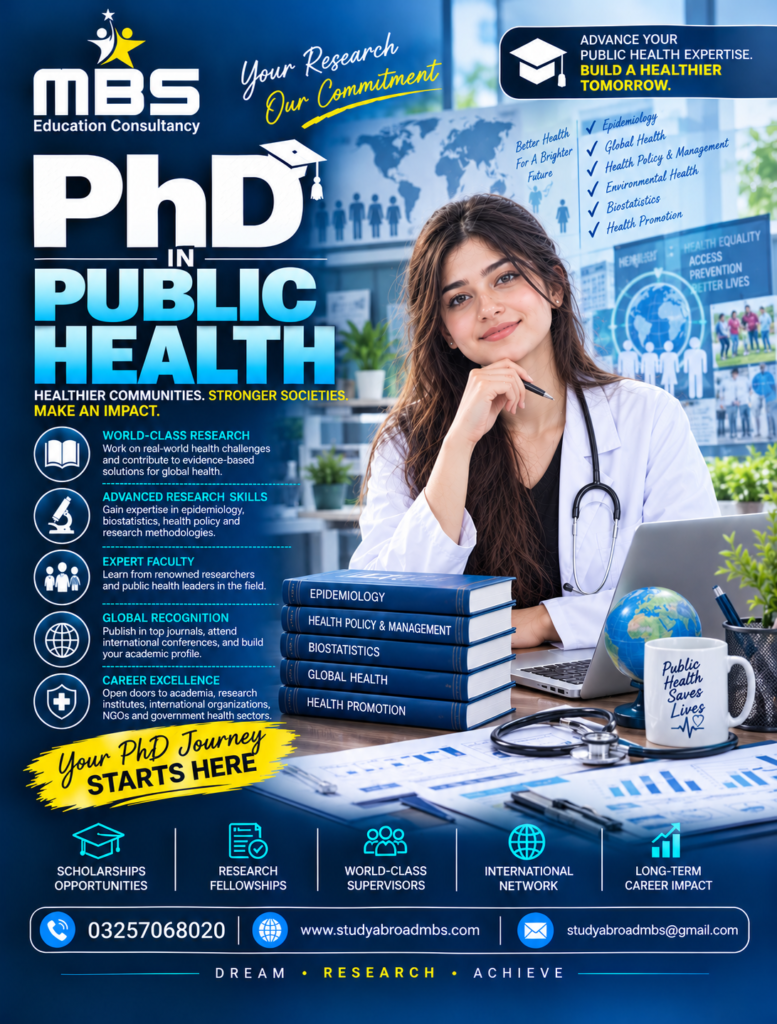
What is a PhD in Public Health?
A PhD in Public Health is primarily a research-focused doctoral degree.
Instead of focusing mainly on classroom study, students normally identify a public health problem, develop a research question, conduct research, analyse data and produce a doctoral thesis.
Public Health focuses on improving the health of populations rather than treating only individual patients.
Research can involve:
- Disease prevention
- Epidemiology
- Health promotion
- Community health
- Health policy
- Healthcare systems
- Environmental health
- Occupational health
- Maternal and child health
- Nutrition
- Mental health
- Global health
- Health economics
- Public health data analysis
PhD in Public Health vs Doctor of Public Health (DrPH)
Students should understand the difference before applying.
A PhD in Public Health is generally designed around original academic research and the production of a doctoral thesis.
A Doctor of Public Health (DrPH) is often a professional doctoral programme that can combine coursework, practical training and research.
For example, UKM describes its Doctor of Public Health as a mixed-mode programme combining coursework and research, while its PhD in Public Health is listed as a research programme.
USM also offers Doctor of Public Health programmes in areas including Epidemiology, Family Health, Environmental Health and Occupational Health, and Health System Management.
Therefore, Pakistani students should check whether they are applying for a PhD or a DrPH.
Why Study PhD in Public Health in Malaysia?
Malaysia has a developed higher education system with universities offering postgraduate study and research in health and medical sciences.
For Pakistani students, studying Public Health in Malaysia can provide:
- International academic exposure
- Research-based doctoral education
- Access to experienced academic supervisors
- Opportunities to conduct population and community health research
- Exposure to different healthcare systems
- Development of advanced research skills
- A multicultural learning environment
- Opportunities to specialise in different areas of Public Health
Popular Research Areas in Public Health
Public Health is a broad field. Depending on the university and available supervisor, students can explore areas such as:
- Epidemiology
- Public Health Policy
- Community Health
- Global Health
- Environmental Health
- Occupational Health
- Health Promotion
- Health Education
- Health System Management
- Health Services Research
- Family Health
- Maternal Health
- Child Health
- Adolescent Health
- Mental Health
- Public Health Nutrition
- Epidemiological Statistics
- Biostatistics
- Infectious Diseases
- Non-Communicable Diseases
- Chronic Disease Prevention
- Cancer Epidemiology
- Cardiovascular Disease
- Diabetes Research
- Obesity and Lifestyle Diseases
- Health Economics
- Healthcare Quality
- Patient Safety
- Digital Health
- Health Informatics
- Primary Healthcare
- Rural Health
- Urban Health
- Reproductive Health
- Ageing and Healthy Ageing
- Population Health
- Health Inequality
- Social Determinants of Health
- Occupational Safety and Health
- Environmental Pollution and Health
- Disaster and Emergency Health
- One Health
- Global Disease Control
Epidemiology
Epidemiology is one of the most important areas of Public Health.
It studies the distribution, causes and risk factors of diseases within populations.
Research may include:
- Infectious disease outbreaks
- Cancer epidemiology
- Diabetes
- Cardiovascular disease
- Maternal and child health
- Disease risk factors
- Population health patterns
- Disease prevention strategies
USM currently offers a Doctor of Public Health in Epidemiology, with admission requiring a Master of Public Health with a minimum CGPA of 3.20/4.00 or a Master of Community Medicine.
Community and Family Health
This area focuses on the health of families and communities.
Possible research topics include:
- Maternal health
- Child health
- Family planning
- Community healthcare
- Preventive healthcare
- Health behaviour
- Rural healthcare
- Community-based interventions
USM lists Family Health among its current Doctor of Public Health specialisations.
Environmental Health
Environmental health examines how environmental conditions can affect human health.
Research may focus on:
- Air pollution
- Water quality
- Waste management
- Chemical exposure
- Climate change
- Environmental diseases
- Food safety
- Occupational environments
Environmental Health and Occupational Health are among the current Public Health doctoral areas listed by USM.
Occupational Health
Occupational Health focuses on protecting workers from health and safety risks.
Research can include:
- Workplace injuries
- Occupational diseases
- Workplace stress
- Chemical exposure
- Industrial safety
- Ergonomics
- Employee wellbeing
- Occupational risk assessment
This field can be relevant for students interested in workplace health, industrial environments and public health policy.
Health System Management
This area focuses on how healthcare systems are organised, managed and improved.
Possible research topics include:
- Healthcare management
- Healthcare quality
- Health policy
- Hospital management
- Primary healthcare
- Healthcare financing
- Patient safety
- Health service delivery
- Healthcare access
- Health system performance
USM currently offers a Doctor of Public Health in Health System Management.
Public Health Nutrition
Public Health Nutrition focuses on nutrition at the population level.
Research can include:
- Malnutrition
- Obesity
- Child nutrition
- Maternal nutrition
- Food security
- Healthy diets
- Nutrition education
- Lifestyle-related diseases
Mental Health and Public Health
Mental health is increasingly studied from a population-health perspective.
Possible research areas include:
- Depression
- Anxiety
- Mental health awareness
- Youth mental health
- Workplace mental health
- Community mental health
- Mental health services
- Social determinants of mental health
Global Health
Global Health focuses on health challenges that affect populations across countries and regions.
Research can involve:
- Infectious diseases
- Health inequalities
- Migration and health
- Global disease prevention
- International health policy
- Health emergencies
- Healthcare access
- Global health systems
Duration of PhD in Public Health in Malaysia
The duration depends on the university and programme structure.
For example, UKM lists its PhD in Public Health as:
Full-time: 6–12 semesters
Part-time: 8–14 semesters
UKM states that international students in this PhD programme are full-time only, with intake throughout the academic year.
USM’s Doctor of Public Health programmes list:
Full-time: Minimum 6 semesters and maximum 10 semesters.
Students should therefore plan for approximately 3 to 5 years, depending on the university, research progress and programme requirements.
Study Structure
A research-based PhD in Public Health may normally involve:
- Selecting a research topic
- Identifying a suitable supervisor
- Preparing a research proposal
- Literature review
- Research methodology
- Data collection
- Statistical or qualitative data analysis
- Research presentations
- Thesis writing
- Thesis examination
- Viva voce
The exact structure depends on the university.
Intakes for 2026–2027
Intakes vary between universities.
UKM currently lists its PhD in Public Health as accepting applications throughout the academic year.
USM’s Doctor of Public Health programmes currently list an October intake.
Students should check the university’s latest admission calendar before submitting an application.
Eligibility for Pakistani Students
The academic requirements depend on the university and the exact Public Health programme.
For example, UKM’s PhD in Public Health has a general requirement of a recognised Master’s degree or equivalent qualification.
USM’s Doctor of Public Health specialisations currently require a Master of Public Health with CGPA 3.20/4.00 or above, or a Master of Community Medicine.
Therefore, Pakistani students should check whether their Master’s degree is considered relevant to the selected programme.
Which Master’s Degrees Can Be Relevant?
Depending on the university and research area, relevant backgrounds may include:
- Master of Public Health
- Master of Community Medicine
- Master of Community Health
- Epidemiology
- Health Sciences
- Medical Sciences
- Biomedical Sciences
- Nursing
- Health Services
- Environmental Health
- Occupational Health
- Health Management
- Nutrition
- Medical Laboratory Sciences
- Pharmacy
- Medicine
- Dentistry
- Other closely related health disciplines
The final decision is made by the university based on its admission requirements.
Can MBBS Students Apply?
MBBS graduates may be eligible for some Public Health doctoral programmes, but the requirements are different from university to university.
For example, UM’s Doctor of Public Health has specific requirements involving a Master’s in Public Health and a medical degree, along with relevant work experience.
Some programmes may therefore be suitable for medical graduates, while others may require a Master’s degree in Public Health or a closely related discipline.
Students should check the exact programme before applying.
English Language Requirements
International students normally need to demonstrate English proficiency unless they qualify for an exemption.
For example, USM’s current Doctor of Public Health programmes list:
- IELTS Band 5
- TOEFL iBT 40
- PTE 47
- Other accepted equivalent tests
USM may consider an exemption where the applicant’s previous degree was taught in English, subject to proof.
Requirements can be higher for some universities and programmes.
For example, UKM lists IELTS 6.5 or an accepted equivalent for international applicants to its Doctor of Public Health programme.
Research Proposal
A research proposal is important for a research-based PhD.
Your proposal should clearly explain:
- Research title
- Background
- Research problem
- Research gap
- Research objectives
- Research questions
- Literature review
- Research methodology
- Target population
- Data collection method
- Data analysis method
- Expected contribution
- References
A strong Public Health proposal should address a real health problem and explain how the research can contribute to better health outcomes, policy or healthcare practice.
Finding a Suitable Supervisor
Choosing the right supervisor is one of the most important steps.
Students should look for a researcher whose current work matches their proposed topic.
For example:
Epidemiology: Look for supervisors working on disease patterns, population health or epidemiological research.
Environmental Health: Look for researchers working on pollution, occupational exposure or environmental risk.
Health Management: Look for supervisors working on healthcare systems, policy or health services research.
Family Health: Look for researchers working on maternal, child or community health.
The availability of a supervisor can affect whether a research application is accepted.
Documents Required
Pakistani students may normally need:
- Valid passport
- Passport-size photograph
- Bachelor’s degree certificate
- Master’s degree certificate
- Bachelor’s transcripts
- Master’s transcripts
- Updated CV
- Research proposal
- English language certificate
- Statement of purpose, if required
- Recommendation letters, if required
- Research publications, if available
- Work experience documents, where required
- Other documents requested by the university
Some documents may need certification, attestation or official translation.
Admission Process for Pakistani Students
Step 1 – Choose Your Public Health Area
Select your preferred research field, such as Epidemiology, Health Management, Environmental Health or Family Health.
Step 2 – Select Malaysian Universities
Find universities offering a suitable Public Health PhD or related doctoral programme.
Step 3 – Check Eligibility
Check your Master’s degree, CGPA, English requirement and any professional experience requirement.
Step 4 – Find a Supervisor
Identify a supervisor whose research interests match your proposed topic.
Step 5 – Prepare Research Proposal
Prepare a clear and realistic research proposal.
Step 6 – Prepare Documents
Collect your academic documents, passport, CV, proposal and English certificate.
Step 7 – Submit Application
Apply through the university’s official postgraduate admission system.
Step 8 – University Assessment
The university may assess your academic qualifications, research proposal and supervisor availability.
Step 9 – Receive Offer Letter
If accepted, follow the university’s instructions for accepting the offer.
Step 10 – Student Visa Process
After admission, complete the required Malaysian student pass process for international students.
Step 11 – Begin Your Doctoral Study
After completing the admission and immigration requirements, you can begin your Public Health studies and research.
Student Visa for Pakistani Students
Pakistani students who receive admission to a Malaysian university must complete the required student pass process.
The exact requirements can depend on the university and current Malaysian immigration procedures.
Students should prepare their passport, admission documents, financial documents and other required paperwork in advance.
PhD in Public Health Fees in Malaysia
Tuition fees vary according to the university and programme.
For example, USM currently lists international tuition for its Doctor of Public Health programmes at USD 36,000 for 90 units, plus registration, personal bond and convocation charges. USM states that the listed fees are subject to change and do not include Malaysia’s 6% SST.
Other universities can have different fee structures, so students should always confirm the latest international fee before applying.
Living Expenses in Malaysia
Apart from tuition, students should budget for:
- Accommodation
- Food
- Transportation
- Mobile and internet
- Study materials
- Health insurance
- Visa-related expenses
- Personal expenses
- Air tickets
Living expenses depend on the city and personal lifestyle.
Scholarships and Funding
Funding opportunities can vary between universities and research projects.
Possible sources may include:
- University scholarships
- Research grants
- Graduate research assistantships
- Faculty funding
- Supervisor-supported research projects
- External scholarships
Funding is competitive and should be confirmed before relying on it for your study budget.
Career Opportunities After PhD in Public Health
A PhD in Public Health can lead to careers in academic research, universities, healthcare organisations, research institutes, government organisations and public health programmes.
Possible career paths include:
- Public Health Researcher
- University Lecturer
- Epidemiologist
- Health Policy Researcher
- Health Services Researcher
- Public Health Consultant
- Health Programme Researcher
- Community Health Researcher
- Environmental Health Researcher
- Occupational Health Researcher
- Global Health Researcher
- Health Data Researcher
- Research Scientist
- Public Health Programme Specialist
- Health Policy Analyst
- Research Officer
Career opportunities depend on the graduate’s specialisation, research experience, publications, professional qualifications and the employment rules of the country where they seek work.
Is PhD in Public Health Difficult?
A PhD in Public Health can be academically demanding because it involves independent research over several years.
Students may need to:
- Read a large amount of research literature
- Develop research questions
- Collect data
- Use statistical or qualitative research methods
- Analyse results
- Write academic papers
- Present research
- Complete a doctoral thesis
Students who enjoy research, data analysis, healthcare issues and solving population-level problems may find the field suitable.
Who Should Study PhD in Public Health?
This programme may be suitable for students who:
- Have a relevant Master’s degree
- Are interested in population health
- Enjoy research and data analysis
- Want to study disease prevention
- Are interested in healthcare policy
- Want to work in public health research
- Want an academic or research career
- Have a clear research interest
- Are prepared for several years of independent research
Advantages for Pakistani Students
A Malaysian PhD in Public Health can provide:
- International academic exposure
- Advanced public health research training
- Experience with research methodologies
- Opportunities to work with international researchers
- Exposure to different healthcare systems
- Specialisation in a public health research area
- Preparation for academic and research careers
Estimated Budget
Your total budget will depend on the university, city, programme duration and lifestyle.
Main expenses include:
1. Tuition Fee
Depends on the selected university and programme.
2. Accommodation
Depends on the city and type of accommodation.
3. Food and Daily Expenses
Depends on personal lifestyle.
4. Visa and Insurance
Required costs for international students.
5. Travel and Personal Expenses
Flights, transportation and personal spending should also be included.
A final budget should be prepared after selecting the university and programme.
Important Things to Check Before Applying
Before applying for a PhD in Public Health in Malaysia, Pakistani students should check:
- Is the programme a PhD or Doctor of Public Health (DrPH)?
- Is it research-based or mixed mode?
- Is your Master’s degree relevant?
- Does your CGPA meet the requirement?
- Is work experience required?
- Is your research topic available?
- Is a suitable supervisor available?
- What IELTS or English requirement applies?
- What is the latest international tuition fee?
- What additional fees are charged?
- What is the intake date?
- Are international students accepted?
- What documents need attestation?
- What are the current student visa requirements?
- Are scholarships or research funding available?
Frequently Asked Questions
Can Pakistani students study PhD in Public Health in Malaysia?
Yes. Pakistani students can apply to eligible Malaysian Public Health doctoral programmes if they meet the university’s academic and English-language requirements.
Do I need a Master’s degree?
For many Public Health PhD programmes, a relevant Master’s degree is required. UKM’s PhD in Public Health accepts a recognised Master’s degree or equivalent qualification, while specific Doctor of Public Health programmes can have additional requirements.
Can an MBBS graduate study Public Health?
Yes, some Public Health doctoral programmes accept medical graduates, but requirements vary. Some programmes may also require a Master’s degree in Public Health and relevant professional experience.
What is the difference between PhD Public Health and DrPH?
A PhD is generally research-focused and designed around original academic research.
A DrPH is generally a professional doctoral degree and may combine coursework, practical training and research.
The exact structure depends on the university.
What IELTS score is required?
It depends on the university. USM currently lists IELTS Band 5 for its Doctor of Public Health programmes, while UKM lists IELTS 6.5 for its international DrPH applicants.
How long does a Public Health PhD take?
The duration depends on the university and study mode. UKM lists its PhD in Public Health at 6–12 semesters full-time and 8–14 semesters part-time.
Can I specialise in Epidemiology?
Yes. Epidemiology is an important Public Health research area, and USM currently offers a Doctor of Public Health in Epidemiology.
Can I research Environmental Health?
Yes. Environmental Health is one of the doctoral Public Health areas currently offered by USM.
Is a research proposal required?
For a research-based PhD, a research proposal is commonly an important part of the application. The exact proposal requirements depend on the university.
Can I work after completing the PhD?
A Public Health PhD can prepare graduates for research, academic, healthcare and policy-related careers. Employment rights depend on the immigration and employment rules of the country where you seek work.
Final Conclusion
A PhD in Public Health in Malaysia 2026–2027 can be a suitable option for Pakistani students who want to develop advanced expertise in population health and public health research.
The field offers many research directions, including Epidemiology, Community Health, Environmental Health, Occupational Health, Health System Management, Family Health, Global Health, Nutrition, Mental Health and Health Policy.
Before applying, students should carefully check whether they are applying for a PhD in Public Health or a Doctor of Public Health (DrPH) because the admission requirements and study structure can be different.
The most important steps are choosing the right research area, finding a suitable supervisor, checking eligibility, preparing a strong research proposal and confirming the latest tuition, intake and visa requirements.
With the right academic background and research interest, a Public Health doctorate can prepare students for advanced careers in research, universities, healthcare organisations, policy and public health programmes.