
Guide for Pakistani Students
A PhD in Biomedical Science is an advanced research degree for students who want to build a career in medical research, laboratory science, biotechnology, healthcare research, pharmaceuticals and higher education.
Malaysia offers research-based PhD opportunities in Biomedical Science and related fields such as molecular biology, genetics, microbiology, immunology, pharmacology, toxicology and medical research.opportunities in biomedical and related health science areas.
For Pakistani students with a relevant Master’s degree, Malaysia can be considered for advanced biomedical research with access to university laboratories, research supervisors and specialised research areas.
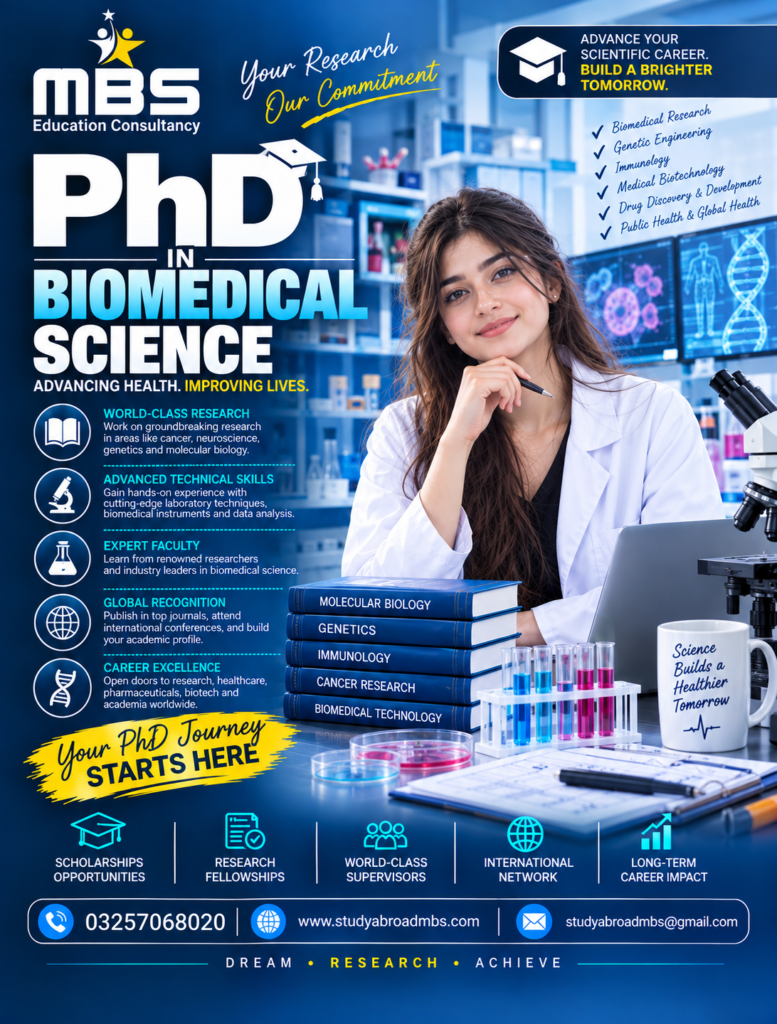
What is a PhD in Biomedical Science?
A PhD in Biomedical Science is mainly a research-based programme. Instead of following a traditional classroom-based degree, students normally select a research topic, work under the guidance of a supervisor, conduct laboratory or scientific research, write a thesis and defend their research.
Biomedical Science connects biology and medicine. It focuses on understanding diseases, human health, diagnosis, treatment, prevention and the biological processes behind different medical conditions.
Depending on the university and supervisor, research may involve laboratory experiments, clinical-related research, molecular studies, data analysis or other scientific methods.
Why Study PhD in Biomedical Science in Malaysia?
Malaysia has developed a strong higher education and research environment in health sciences and biomedical research.
Some universities offer research opportunities in areas including molecular and cellular biology, immunology, microbiology, pharmacology, toxicology, genetics and other biomedical disciplines.
For Pakistani students, studying in Malaysia can provide:
- Research-based doctoral education
- Access to university laboratories and research facilities
- International academic exposure
- Opportunity to work with experienced supervisors
- Research opportunities in medical and health sciences
- A multicultural study environment
- Opportunities to develop academic and scientific research skills
Popular Research Areas in Biomedical Science
Biomedical Science is a broad field. Depending on the university and available supervisor, students may choose research in areas such as:
- Molecular Biology
- Cellular Biology
- Medical Microbiology
- Immunology
- Genetics
- Human Genetics
- Biochemistry
- Pharmacology
- Toxicology
- Physiology
- Hematology
- Pathology
- Parasitology
- Virology
- Cancer Biology
- Stem Cell Research
- Molecular Medicine
- Medical Biotechnology
- Vaccinology
- Infectious Diseases
- Drug Discovery
- Natural Products Research
- Diagnostic Science
- Biomedical Imaging
- Reproductive Biology
- Neuroscience
- Clinical Research
- Health Sciences
- Bioinformatics
- Genomics
- Proteomics
USM, for example, lists research areas including vaccinology, molecular and cellular biology, pharmacology, physiology, immunology, haematology and transfusion sciences, biochemistry, microbiology, parasitology, toxicology and anatomy under its PhD in Biomedicine.
Molecular and Cellular Biology
This area focuses on understanding how cells work and how biological processes can contribute to disease.
Research can include:
- Cell signaling
- Gene expression
- Cellular mechanisms
- Molecular pathways
- Cancer biology
- Stem cells
- Cellular responses to disease
Medical Microbiology and Immunology
This area focuses on microorganisms, infectious diseases and the human immune system.
Possible research topics include:
- Bacteria and viruses
- Infectious diseases
- Antimicrobial resistance
- Immune responses
- Vaccine research
- Host-pathogen interactions
- Diagnostic methods
Genetics and Molecular Medicine
Students interested in genetics can research genetic diseases, molecular mechanisms and the role of genes in human health.
Possible areas include:
- Genetic disorders
- Human genetics
- Molecular diagnostics
- Genomics
- Gene expression
- Genetic testing
- Precision medicine
Pharmacology and Toxicology
This field studies how drugs and chemicals affect biological systems.
Research may include:
- Drug development
- Drug safety
- Pharmacological mechanisms
- Toxicity testing
- Natural products
- Environmental toxins
- Therapeutic compounds
Cancer and Stem Cell Research
Biomedical researchers can also work in areas related to cancer and regenerative medicine.
Research may involve:
- Cancer biology
- Cancer biomarkers
- Molecular mechanisms of cancer
- Stem cell biology
- Cell differentiation
- Regenerative medicine
- Drug testing
Duration of PhD in Biomedical Science in Malaysia
The duration depends on the university, study mode and research progress.
For example, USM lists its PhD in Biomedicine as:
Full-time: Minimum 4 semesters and maximum 10 semesters
Part-time: Minimum 6 semesters and maximum 15 semesters
UKM’s Biomedical Science PhD is offered as a research programme, with international students listed under full-time study.
A student should therefore plan for approximately 3 to 5 years, depending on the university, research progress and programme requirements.
Study Structure
A PhD in Biomedical Science is normally research-focused.
The typical structure may include:
- Selecting a research area
- Finding a suitable supervisor
- Preparing a research proposal
- Registering for the PhD
- Conducting research
- Laboratory or field work
- Analysing research data
- Presenting research progress
- Writing a doctoral thesis
- Thesis examination and viva voce
The exact structure can differ between universities.
Intakes for 2026,2027
Intake dates depend on the university and programme.
Research-based PhD programmes can have more flexible application periods than coursework programmes. For example, UKM states that applications for research-mode programmes can be made throughout the year.
Pakistani students should therefore check the specific university, supervisor availability and application deadline before planning their admission.
Eligibility for Pakistani Students
Generally, applicants should have a relevant Master’s degree.
For example, USM accepts applicants with:
- A Master’s degree in research mode; or
- A Master’s degree in a related field with CGPA 3.00/4.00; or
- A Master’s degree in a related field with CGPA 2.50–2.99/4.00 subject to additional requirements.
USM also provides a fast-track route for certain applicants holding a related Bachelor’s degree with a minimum CGPA of 3.67/4.00.
UKM’s Biomedical Science PhD entry requirement is a Master’s degree in a related field or an equivalent qualification recognised by the university.
Which Master’s Degrees Can Be Relevant?
Depending on the university and research area, relevant backgrounds may include:
- Biomedical Science
- Biotechnology
- Biological Sciences
- Biochemistry
- Microbiology
- Molecular Biology
- Genetics
- Pharmacy
- Pharmacology
- Medical Laboratory Sciences
- Health Sciences
- Medical Sciences
- Life Sciences
- Public Health
- Other closely related disciplines
The final decision depends on the university and proposed research area.
English Language Requirements
International students normally need to demonstrate English proficiency.
Requirements vary by university.
For example, USM lists a minimum IELTS Band 5 for its PhD in Biomedicine, while UKM’s Biomedical Science PhD page lists IELTS 5.5.
Some universities may accept TOEFL or other recognised English-language qualifications.
Students should always check the current requirement of the university before applying.
Research Proposal
A research proposal is an important part of a research-based PhD application.
A good proposal normally explains:
- Research title
- Background of the study
- Research problem
- Research objectives
- Research questions
- Literature review
- Proposed methodology
- Expected results
- Importance of the research
- References
For Biomedical Science, the proposal should clearly explain the scientific problem and how the proposed research can contribute to existing knowledge.
Finding a PhD Supervisor
Choosing the right supervisor is very important for Biomedical Science.
Students should search for a supervisor whose current research matches their proposed topic.
For example, if your interest is cancer research, you should look for researchers working in cancer biology, molecular medicine or related areas.
If your interest is infectious disease, look for supervisors working in microbiology, virology, immunology or infectious disease research.
USM specifically encourages postgraduate applicants to identify suitable research areas and potential supervisors.
Documents Required
Pakistani students will normally need documents such as:
- Passport
- Passport-size photograph
- Bachelor’s degree certificate
- Master’s degree certificate
- Bachelor’s transcripts
- Master’s transcripts
- Updated CV
- Research proposal
- English language certificate
- Academic references, if required
- Statement of purpose, if required
- Research publications, if available
- Experience letters, if applicable
- Other documents requested by the university
Documents may need to be attested, certified or translated depending on university requirements.
Admission Process for Pakistani Students
The general process is:
Step 1 – Choose Your Research Area
Select your preferred Biomedical Science research field.
Step 2 – Find Suitable Universities
Look for Malaysian universities offering Biomedical Science or closely related PhD research areas.
Step 3 – Find a Supervisor
Review faculty research areas and identify a suitable supervisor.
Step 4 – Prepare Your Research Proposal
Develop a clear proposal related to the supervisor’s research expertise.
Step 5 – Prepare Documents
Collect your academic certificates, transcripts, passport, CV, English certificate and other required documents.
Step 6 – Submit Application
Submit the application according to the university’s postgraduate admission process.
Step 7 – Receive Admission Decision
The university may assess your academic background, research proposal and supervisor availability.
Step 8 – Accept the Offer
If accepted, complete the required acceptance and payment procedures.
Step 9 – Student Visa Process
After admission, eligible international students proceed with the required Malaysian student pass/visa process.
Step 10 – Start Your PhD
After completing the required formalities, students can begin their doctoral research in Malaysia.
Student Visa for Pakistani Students
Pakistani students admitted to a Malaysian university need to complete the required student pass process for international students.
The exact process depends on the university and Malaysian immigration requirements.
Students should make sure their passport, admission documents, financial documents and other required paperwork are ready before beginning the visa process.
PhD Biomedical Science Fees in Malaysia
Fees vary significantly between universities.
As one current example, USM lists international tuition for its PhD in Biomedicine at USD 2,500 per semester for full-time students, plus listed registration, thesis evaluation, convocation and research methodology charges. USM states that the listed fees do not include Malaysia’s 6% SST and that fees can change.
Other Malaysian universities can have different fee structures, so students should not assume that one university’s fee applies to all Biomedical Science PhD programmes.
Living Expenses in Malaysia
Apart from tuition fees, Pakistani students should budget for:
- Accommodation
- Food
- Local transportation
- Mobile and internet
- Study materials
- Health insurance
- Personal expenses
- Visa and related charges
Living costs depend heavily on the city and lifestyle.
Students living outside major city centres may be able to manage their monthly expenses differently from students living in central Kuala Lumpur.
Scholarships and Funding
Scholarships and research funding may be available depending on the university, faculty, supervisor and research project.
Possible sources can include:
- University scholarships
- Research grants
- Graduate research assistantships
- Faculty funding
- Supervisor-supported research projects
- External scholarships
Funding is competitive and should never be assumed to be automatically available with admission.
Career Opportunities After PhD in Biomedical Science
A PhD in Biomedical Science can lead to careers in research, academia, healthcare-related industries and scientific organisations.
Possible career paths include:
- Biomedical Researcher
- University Lecturer
- Research Scientist
- Medical Research Scientist
- Molecular Biology Researcher
- Microbiology Researcher
- Immunology Researcher
- Clinical Researcher
- Pharmaceutical Researcher
- Biotechnology Scientist
- Laboratory Research Scientist
- Toxicology Researcher
- Drug Discovery Researcher
- Research and Development Scientist
- Scientific Consultant
- Research Officer
- Healthcare Research Specialist
Graduates may work in universities, research institutes, hospitals, pharmaceutical companies, biotechnology companies, diagnostic laboratories and government or private research organisations.
Is PhD in Biomedical Science Difficult?
Yes, it can be academically demanding because it is a research-intensive degree.
Students may need to spend several years working on one research problem, conducting experiments, analysing scientific data and writing a thesis.
The difficulty also depends on the research topic, laboratory work, available facilities, supervisor support and the student’s academic background.
Students who enjoy scientific research, laboratory work, problem-solving and independent study may find the programme more suitable.
Who Should Study PhD in Biomedical Science?
This programme may be suitable for students who:
- Have a relevant Master’s degree
- Enjoy scientific research
- Are interested in medicine and biology
- Want to work in biomedical research
- Are interested in laboratory-based research
- Want to become university researchers or lecturers
- Want to work in biotechnology or pharmaceutical research
- Have a clear research interest
- Are prepared for several years of independent research
Advantages for Pakistani Students
A Malaysian PhD in Biomedical Science can provide Pakistani students with:
- International research exposure
- Advanced academic training
- Experience with modern research methods
- Opportunities to work with international researchers
- Access to specialised biomedical research areas
- Potential career opportunities in academia and research
- A pathway towards specialised scientific careers
Estimated Budget
Your total budget will depend on the university, city, programme duration and lifestyle.
A Pakistani student should consider these main expenses:
1. University Tuition Fee
Depends on the university and programme.
2. Accommodation
Depends on location and type of accommodation.
3. Food and Daily Expenses
Depends on personal lifestyle.
4. Visa and Insurance
Required costs for international students.
5. Travel and Personal Expenses
Flights, transportation and other personal costs should also be included.
A complete budget should be calculated after selecting the university because PhD fees can vary considerably.
Important Things to Check Before Applying
Before applying for a PhD in Biomedical Science in Malaysia, Pakistani students should check:
- Is the programme specifically Biomedical Science, Biomedicine or a related PhD?
- Is the programme research-based?
- Is your Master’s degree considered relevant?
- Does your CGPA meet the requirement?
- Is your research topic available?
- Is a suitable supervisor available?
- What English test is accepted?
- What is the current international tuition fee?
- What additional university charges apply?
- What are the application and intake dates?
- What documents need attestation?
- What are the current student visa requirements?
- Is scholarship or research funding available?
Frequently Asked Questions
Can Pakistani students apply for a PhD in Biomedical Science in Malaysia?
Yes. Pakistani students can apply for eligible Malaysian PhD programmes if they meet the university’s academic, English-language and other admission requirements.
Do I need a Master’s degree?
In most cases, yes. For example, UKM requires a Master’s degree in a related field for its Biomedical Science PhD, while USM provides several admission routes based on the applicant’s qualifications.
Can a student with a Biotechnology Master’s apply?
A Biotechnology Master’s can be relevant to Biomedical Science research, depending on the proposed research area and university requirements. The university makes the final assessment.
Can MBBS graduates apply?
An MBBS background may be relevant to some biomedical or medical research programmes, but eligibility depends on the specific university and research area.
Is PhD Biomedical Science coursework-based?
Most programmes in this area are strongly research-oriented. For example, UKM lists its Biomedical Science PhD as research-only.
Can I do research in cancer or genetics?
Yes. Depending on the university and available supervisor, research can include cancer biology, genetics, molecular biology, stem cells, immunology and related areas.
What IELTS score is required?
It varies. For example, USM lists IELTS Band 5 for its PhD in Biomedicine, while UKM lists IELTS 5.5 on its Biomedical Science PhD entry page.
How long does the PhD take?
The duration depends on the university and study mode. USM lists a minimum of 4 semesters for full-time and 6 semesters for part-time study for its PhD in Biomedicine.
Is a research proposal required?
For research-based PhD applications, a research proposal is commonly an important part of the application. Requirements vary by university and faculty.
Can I work after completing my PhD?
A PhD can prepare graduates for research, academic, pharmaceutical, biotechnology, healthcare and other scientific careers. Employment and work rights depend on the country and the relevant immigration and employment rules.
Final Conclusion
A PhD in Biomedical Science in Malaysia 2026–2027 can be an option for Pakistani students who want to build advanced expertise in biomedical and medical research.
The field covers a wide range of areas, including molecular biology, genetics, microbiology, immunology, pharmacology, toxicology, cancer research, stem cell research and molecular medicine.
Because a PhD is primarily a research degree, choosing the right research topic and supervisor is one of the most important parts of the admission process.
Pakistani students should compare universities carefully, verify current eligibility and English requirements, confirm supervisor availability and calculate the complete tuition and living budget before applying.
For students with a relevant academic background and a genuine interest in scientific research, Biomedical Science can provide a pathway toward advanced research and academic careers.