
Guide for Pakistani Students
Introduction
A Master in Finance is a postgraduate degree designed for students who want to develop advanced knowledge of financial management, investment, banking, financial markets, risk management and corporate finance.
The program is suitable for students who want to build careers in banking, investment, financial analysis, corporate finance, insurance and other financial services.
Malaysia is an attractive destination for international students because it offers a multicultural learning environment, a developing financial sector and comparatively affordable education and living costs.
For Pakistani students planning to study in Malaysia during the 2026–2027 intake, a Master in Finance can provide strong academic and professional preparation for careers in the local and international finance industry.
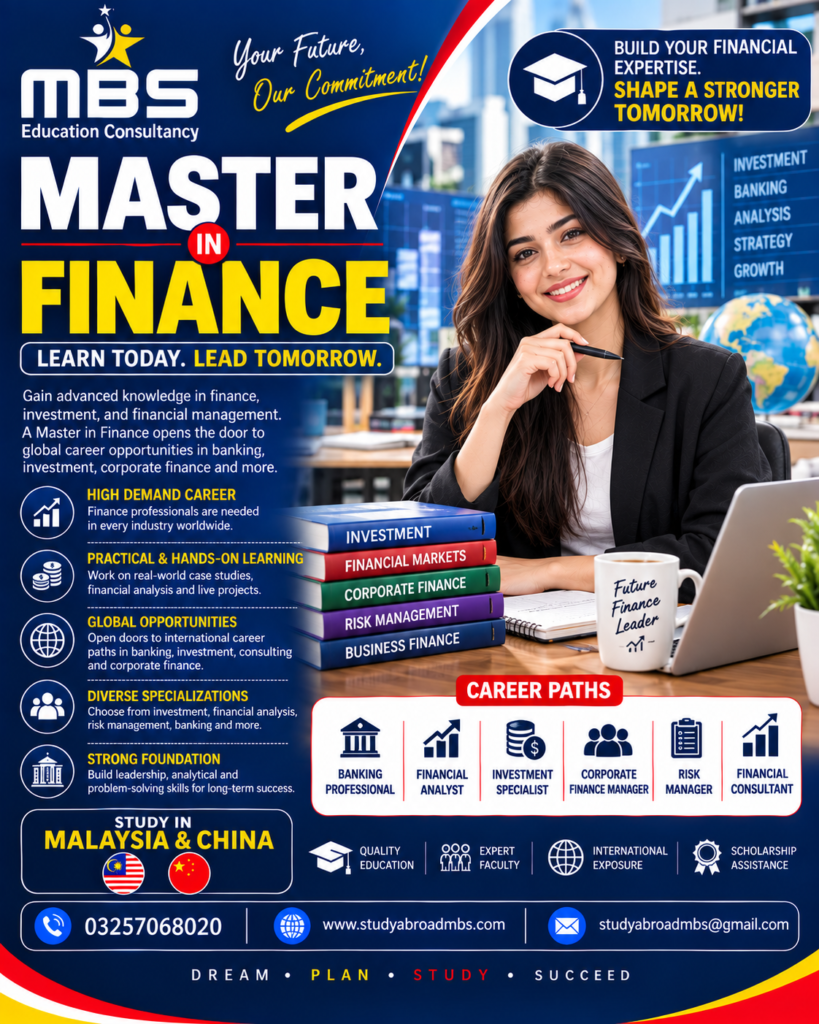
What Is a Master in Finance?
A Master in Finance focuses on advanced financial concepts and their practical application in businesses and financial institutions.
Students learn how to analyses financial information, evaluate investments, manage financial risks and make strategic financial decisions.
Depending on the university, the program may cover:
- Corporate Finance
- Investment Management
- Financial Markets
- Financial Analysis
- Risk Management
- Portfolio Management
- International Finance
- Banking
- Financial Modelling
- Corporate Valuation
- Financial Economics
- FinTech
- Islamic Finance
- Research Methods
Some institutions offer coursework-based programs, while others may provide research or mixed-mode options.
Quick Overview
| Category | Details |
| Program | Master in Finance |
| Study Level | Postgraduate / Master’s Degree |
| Study Destination | Malaysia |
| Intake | 2026–2027 |
| Typical Duration | 1–2 Years |
| Study Mode | Full-Time / Part-Time |
| Medium of Instruction | English |
| Estimated Tuition Fee | RM 25,000 – RM 50,000+ |
| Academic Background | Finance, Accounting, Business, Economics or Related Field |
| International Students | Yes |
| Career Areas | Banking, Investment, Finance, Insurance and Corporate Sector |
Why Study Finance in Malaysia?
Affordable Education
Malaysia can be a cost-effective option for international students compared with several other popular study destinations.
Strong Business Environment
Malaysia has an established banking, financial services and corporate sector, providing a relevant environment for students interested in finance.
English-Taught Education
Many postgraduate programs are taught in English, making Malaysia accessible to international students.
International Exposure
Students can study in a multicultural environment and interact with classmates from different countries.
Growing Financial Technology Sector
Modern finance is increasingly connected with technology. Areas such as digital banking, financial technology, data analytics and digital payments are creating new career opportunities.
What Will You Study?
The exact subjects depend on the university and program structure.
| Study Area | Possible Subjects |
| Corporate Finance | Corporate Financial Management |
| Investment | Investment Analysis |
| Markets | Financial Markets |
| Banking | Banking and Financial Services |
| Risk | Financial Risk Management |
| Portfolio | Portfolio Management |
| Analysis | Financial Statement Analysis |
| Valuation | Business and Corporate Valuation |
| Economics | Financial Economics |
| Technology | FinTech and Digital Finance |
| International | International Finance |
| Research | Research Methods |
Popular Areas of Specialization
Depending on the university, students may focus on:
- Corporate Finance
- Investment Management
- Banking and Finance
- Financial Risk Management
- Financial Markets
- Portfolio Management
- International Finance
- Islamic Finance
- Financial Technology
- Financial Economics
- Wealth Management
- Financial Analysis
- Corporate Valuation
Duration of the Program
The duration varies depending on the university and study mode.
| Study Mode | Typical Duration |
| Full-Time Coursework | Around 1–2 Years |
| Mixed Mode | Around 1.5–2 Years |
| Research-Based | Around 2 Years or More |
| Part-Time | Usually Longer |
Students should confirm the exact duration before applying because program structures differ between institutions.
Intakes in Malaysia
Intake dates vary between universities.
Common intake periods may include:
- January
- February/March
- May/June
- September/October
For the 2026–2027 intake, students should check the exact intake availability and application deadline before submitting their application.
Estimated Tuition Fees
Tuition fees depend on the university, program structure and duration.
| Expense | Estimated Cost |
| Master’s Tuition Fee | RM 25,000 – RM 50,000+ |
| Application/Registration Charges | Varies |
| Student Visa/Related Charges | Varies |
| Insurance | Varies |
| Books and Study Materials | Varies |
These are estimated planning figures. Actual tuition fees can vary between institutions.
Cost of Living in Malaysia
The cost of living depends on the city, accommodation and personal lifestyle.
| Expense | Estimated Monthly Cost |
| Accommodation | RM 500 – RM 1,200 |
| Food | RM 500 – RM 900 |
| Transportation | RM 100 – RM 300 |
| Mobile/Internet | RM 50 – RM 150 |
| Personal Expenses | RM 200 – RM 400 |
| Approximate Total | RM 1,350 – RM 2,950 |
Students who choose shared accommodation and manage their daily expenses carefully may be able to reduce their monthly budget.
Estimated Total Study Budget
Students should prepare a complete financial plan that includes tuition, accommodation, food, transportation, visa-related expenses and personal costs.
| Budget Category | Estimated Range |
| Tuition Fee | RM 25,000 – RM 50,000+ |
| Living Expenses | RM 16,000 – RM 30,000+ per year |
| Visa, Insurance & Other Costs | Varies |
| Overall Budget | Depends on University and Lifestyle |
Admission Requirements
Requirements vary between Malaysian universities, but applicants generally need:
- A recognized bachelor’s degree
- Relevant academic background
- Academic transcripts
- Degree certificate
- English language proficiency
- Valid passport
- Updated CV
- Personal statement or study plan, where required
- Recommendation letters, where required
- Work experience, where required
Some universities may accept students from related business, accounting or economics backgrounds.
Eligibility for Pakistani Students
Pakistani students can apply for a Master’s in Finance if they meet the academic and English-language requirements of the selected university.
Relevant bachelor’s degrees may include:
- BS Finance
- Bachelor of Finance
- BS Accounting and Finance
- B.Com
- Bachelor of Accounting
- Bachelor of Business Administration
- BS Economics
- Banking and Finance
- Other related business degrees
Applicants from related disciplines may also be considered depending on the university’s admission requirements.
English Language Requirements
Many postgraduate finance programs are taught in English, so international students may need to provide evidence of English proficiency.
| Test | Typical Requirement |
| IELTS | Around 6.0, depending on university |
| TOEFL | University dependent |
| Other Accepted Tests | Depending on institution |
| Alternative English Evidence | May be accepted in some cases |
The exact requirement varies by university and should be confirmed before application.
Documents Required
Pakistani students should normally prepare:
- Valid Passport
- Bachelor’s Degree Certificate
- Academic Transcripts
- Passport-size Photograph
- Updated CV
- English Language Certificate, if required
- Personal Statement or Study Plan, if required
- Recommendation Letters, if required
- Work Experience Documents, if applicable
- Other documents requested by the university
Students with professional experience in banking, accounting, investment or finance should clearly mention their experience in their CV.
Application Process
Step 1 – Choose Your Program
Select a Master in Finance program according to your academic background and career goals.
Step 2 – Check Eligibility
Review the university’s academic, English-language and other admission requirements.
Step 3 – Prepare Documents
Prepare your passport, degree, transcripts, CV and other required documents.
Step 4 – Submit the Application
Complete the application and submit the required documents.
Step 5 – Receive the Offer Letter
If your application is successful, the university may issue an admission or offer letter.
Step 6 – Accept the Offer
Follow the institution’s instructions for accepting the offer and completing the required formalities.
Step 7 – Student Visa Process
Proceed with the Malaysian student pass and visa procedures for international students.
Step 8 – Travel to Malaysia
After receiving the necessary approvals, arrange your travel and prepare for university registration.
Student Visa Process for Pakistani Students
International students need the appropriate Malaysian student pass and visa arrangements before beginning their studies.
The general process involves:
- University admission
- Submission of required student information
- Student pass application
- Immigration procedures
- Required medical or insurance procedures
- Visa approval
- Travel arrangements
- University registration after arrival
Students should follow the latest instructions provided during their admission and visa process.
Scholarships and Financial Support
Eligible international students may find different scholarship and financial-support opportunities in Malaysia.
Possible opportunities may include:
- University scholarships
- Merit-based awards
- Tuition fee assistance
- Research funding
- Government scholarship schemes
- Other institutional financial support
Scholarship eligibility and deadlines vary. Students should check the conditions carefully and apply as early as possible.
Research-Based Master in Finance
Students interested in research, academia or future PhD studies may consider a research-based master’s program where available.
Possible research areas include:
- Corporate Finance
- Investment Management
- Financial Markets
- Banking
- Risk Management
- Islamic Finance
- Financial Technology
- Behavioral Finance
- International Finance
- Sustainable Finance
- Corporate Governance
- Financial Economics
Research-based programs may require students to prepare a research proposal and complete a dissertation.
Career Opportunities After Master in Finance
A Master’s in Finance can prepare graduates for a wide range of financial and business careers.
Potential positions include:
- Financial Analyst
- Finance Manager
- Investment Analyst
- Investment Manager
- Corporate Finance Analyst
- Risk Analyst
- Financial Consultant
- Portfolio Manager
- Treasury Analyst
- Banking Officer
- Credit Analyst
- Financial Planning Specialist
- Wealth Management Specialist
- Corporate Finance Specialist
- Business Analyst
- Finance Executive
Career opportunities depend on qualifications, professional experience, skills and employer requirements.
Industries You Can Work In
Finance graduates can work across many industries, including:
- Banks
- Investment Firms
- Insurance Companies
- Financial Services
- Accounting and Consulting Firms
- Manufacturing
- Technology
- E-commerce
- Telecommunications
- Real Estate
- Healthcare
- Government and Public Sector
- Investment Management
- Corporate Businesses
- FinTech Companies
Professional Qualifications
Students interested in professional finance careers may also consider additional qualifications after or alongside their master’s degree.
Depending on their career goals, they may explore professional certifications in areas such as:
- Investment Management
- Financial Analysis
- Risk Management
- Accounting
- Banking
- Financial Planning
Professional qualifications can complement a master’s degree and may help students develop specialized expertise.
Skills You Can Develop
Financial Skills
- Financial analysis
- Investment analysis
- Corporate finance
- Financial modelling
- Risk management
- Portfolio management
- Budgeting
- Business valuation
Analytical Skills
- Data analysis
- Financial forecasting
- Decision making
- Problem solving
- Market analysis
- Strategic thinking
Professional Skills
- Communication
- Leadership
- Teamwork
- Presentation
- Negotiation
- Business planning
- Research
Is Master in Finance Suitable for Pakistani Students?
Yes, it can be a strong option for Pakistani students with an academic background in finance, accounting, business, economics or related fields.
It may be particularly suitable for students who want to:
- Build a career in banking
- Enter investment management
- Work in corporate finance
- Develop financial analysis skills
- Move into management positions
- Work in FinTech
- Develop expertise in risk management
- Continue toward a PhD
- Build an international finance career
Who Should Study This Degree?
A Master in Finance may be suitable for:
- Finance graduates
- Accounting graduates
- B.Com graduates
- Accounting and Finance graduates
- Business graduates
- Economics graduates
- Banking professionals
- Investment professionals
- Financial analysts
- Business professionals
Important Things to Check Before Applying
Before selecting a university, students should carefully check:
- University recognition
- Program accreditation
- Exact tuition fee
- Program duration
- Available intake
- Entry requirements
- English requirements
- Course structure
- Coursework or research mode
- Professional qualification recognition, where applicable
- Scholarship opportunities
- Accommodation
- Total study budget
- Student visa requirements
Frequently Asked Questions
Is Master in Finance available in Malaysia?
Yes. Malaysian universities offer postgraduate programs in finance, financial management, banking and related fields.
How long does a Master’s in Finance take?
A full-time master’s program commonly takes around 1 to 2 years, depending on the university and study structure.
What is the estimated tuition fee?
International students should generally plan for approximately RM 25,000 to RM 50,000 or more, although actual fees vary by institution.
Can Pakistani students apply?
Yes. Pakistani students can apply if they meet the academic, English-language and other admission requirements.
Can I apply with a B.Com degree?
Yes, a B.Com or another relevant accounting, finance or business qualification may be accepted by many programs, depending on the university.
Can I study Finance after an Accounting degree?
Yes. Accounting graduates can often apply for finance master’s programs if they meet the university’s entry requirements.
Is work experience required?
Not always. Some universities accept students directly after their bachelor’s degree, while others may prefer or require relevant professional experience.
Is Finance a good career choice?
Finance is a broad field with opportunities in banking, investment, insurance, corporate finance, consulting, financial technology and many other industries.
Can I work in banking after completing this degree?
Yes. A Master’s in Finance can provide relevant knowledge for banking and financial-services careers, although individual job requirements vary.
Can I continue to a PhD?
Yes. Students interested in research and academia can progress toward a PhD in finance, economics, business or related fields, subject to university admission requirements.
Final Checklist for Pakistani Students
Before applying for the 2026–2027 intake, make sure you have:
☑ Valid passport
☑ Bachelor’s degree
☑ Academic transcripts
☑ English language evidence
☑ Updated CV
☑ Work experience documents, if applicable
☑ Personal statement/study plan, if required
☑ Recommendation letters, if required
☑ Financial plan
☑ Admission documents
☑ Student visa/pass documents
Final Thoughts
A Master in Finance in Malaysia can be a valuable choice for students who want to develop advanced knowledge of financial management, investment, banking, risk management and corporate finance.
For Pakistani students, the program can provide a pathway toward careers in banks, financial institutions, investment companies, corporations, consulting firms and the growing FinTech sector.
Before applying for the 2026–2027 intake, students should carefully compare the curriculum, tuition fees, admission requirements, professional opportunities and overall study costs.
The right program should match your previous education, career goals, preferred finance specialisation and budget.